
Google recently published a guide on how websites can consistently appear in its AI search results. It stated that having a strong SEO strategy is still the most important thing and that newer practices like AEO and GEO in digital marketing are ‘still SEO.’ That same month, Ahrefs published data showing that whenever an AI Overview appears for a search term, the top-ranking result loses 58% of its clicks.
In other words – you can optimize your website for specific sets of search terms with an uber-strong SEO strategy. But if users only read Google’s AI overviews when they look up those terms – your site will barely get any visitors — even if it ranks high. And if users look up those same terms on other AI engines – again, your perfectly optimized website will receive zero traction.
So, ranking well is no longer an effective way to give your website maximum visibility — especially in this age of AI where users no longer use just Google Search to seek out brand or product-related information. So, the importance of AEO and GEO in digital marketing today cannot be overstated.
But what are these practices? We’ll explain what GEO & AEO optimization means – with examples- and share some easy-to-implement ‘hacks’ on how to get both practices right.
What GEO & AEO Optimization Means?
Both practices aim to improve how frequently your website content gets found, understood, used, and cited in AI-generated answers. They just emphasize different halves of that goal:
What is Generative Engine Optimization (GEO)?
Generative Engine Optimization (GEO) is the practice of optimizing your website in a way that increases the chances of generative AI systems (like ChatGPT, Gemini, Perplexity, etc.) retrieving, referencing, or citing your content whenever they synthesize answers.
When users ask these AI engines questions related to topics or products your brand is related to, GEO is the work that can potentially make your brand part of their synthesized answers. In practice, GEO is concerned with whether popular AI systems have enough reliable information to understand:
- What your brand does
- Why it is relevant to specific topics
- Whether it deserves a place in its answers related to those topics
What is Answer Engine Optimization (AEO)?
Answer Engine Optimization (AEO) is the practice of structuring your website’s content in ways that help AI engines quickly pull clear, self-contained answers to specific questions users ask.
Remember when SEO teams were being asked to optimize their content in ways that make their sites appear on Google’s featured snippets or voice search results?
The practice of AEO is built on similar principles, but it aims to make a website’s content appear in AI-powered summaries and conversational search platforms.
Suppose someone asks an AI chatbot, ‘How do I choose a moisturizer for oily skin?’ Now, let’s say your brand sells moisturizers. Then, your website must have a page that directly explains:
- What types of moisturizers to look for?
- Which ingredients serve which purposes?
- What to avoid?
That makes your website’s content easier to retrieve, understand, and present as a summarized answer for AI chatbots. Investing in this form of content-building and AEO will increase your website’s chances of frequently being hunyxsabij cited in such short, summarized answers.
GEO is the broader practice that aims to make your website a credible source for all similar queries related to the topic at hand (in this example, moisturizers). Then, your GEO-optimized site will be included and represented in all wider, synthesized responses to similar queries.
Ultimately, investing in both GEO & AEO optimization means making your website content useful, understandable, and discoverable for AI engines and AI engine users.
And yes — Google itself insists all of this is just part of SEO. But here’s why investing specifically in those two practices (on top of SEO) is crucial for your brand’s online visibility today.
Why Are GEO and AEO Important for Businesses?
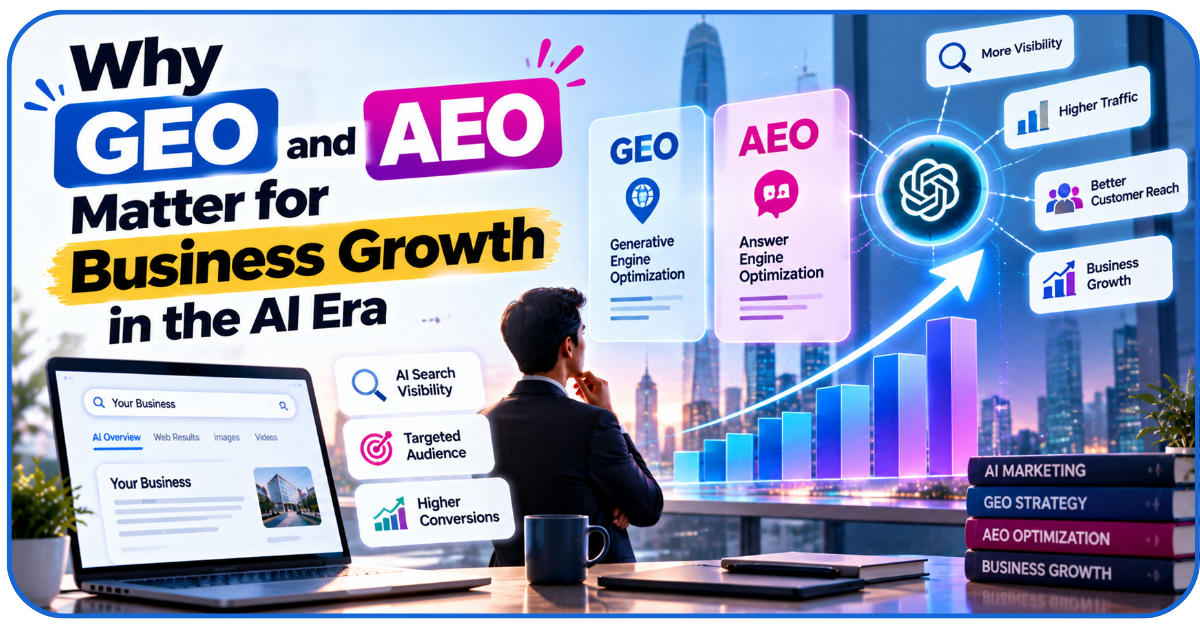
Extending your brand’s online-visibility-enhancing efforts from just SEO to AEO and GEO is of vital importance today because the way consumers seek out information has changed completely.
How Customers Research Has Changed
Users no longer type fragmented keywords. They ask complex, multi-variable questions. A customer researching software or skincare may ask an AI system to compare several options. The resulting answer can influence which businesses the customer considers before visiting any of their websites.
So, if your customers research before they buy, this is where your visibility is being decided – inside the AI answers. So, that is where your brand’s online visibility optimization efforts must begin.
Citations Now Matter More Than Rank Alone
A recent study found that brands that are frequently cited in AI Overviews earn about 120% more organic clicks per impression than uncited brands on the very same results.
These brands tend to make efforts to include AEO and GEO in digital marketing.
Buyer Journey: Awareness and Consideration
Even if a citation doesn’t produce an immediate website click/visit, just being mentioned or cited in AI answers builds brand awareness and influences user consideration in the long run.
They may ask ChatGPT a question today, build a short-list of preferred brands tomorrow, and then visit the website to make a purchase a week later.
None of This Replaces SEO
Google says its AI features are rooted in the same core ranking and quality systems as classic search and SEO. Microsoft agrees with that. Both AI leaders say that in order for websites to be used as reliable sources by their AI engines, they need to have proper:
- Crawlability
- Metadata
- Internal linking
- Keyword use
- Backlinks
So, SEO is still critically important. If you invest in AEO or GEO on top of SEO – that’ll further boost your site’s ability to influence consumer choices in AI answers. But which one should you invest in?
Let’s understand their differences to find out.
AEO vs. GEO: What Are the Key Differences?
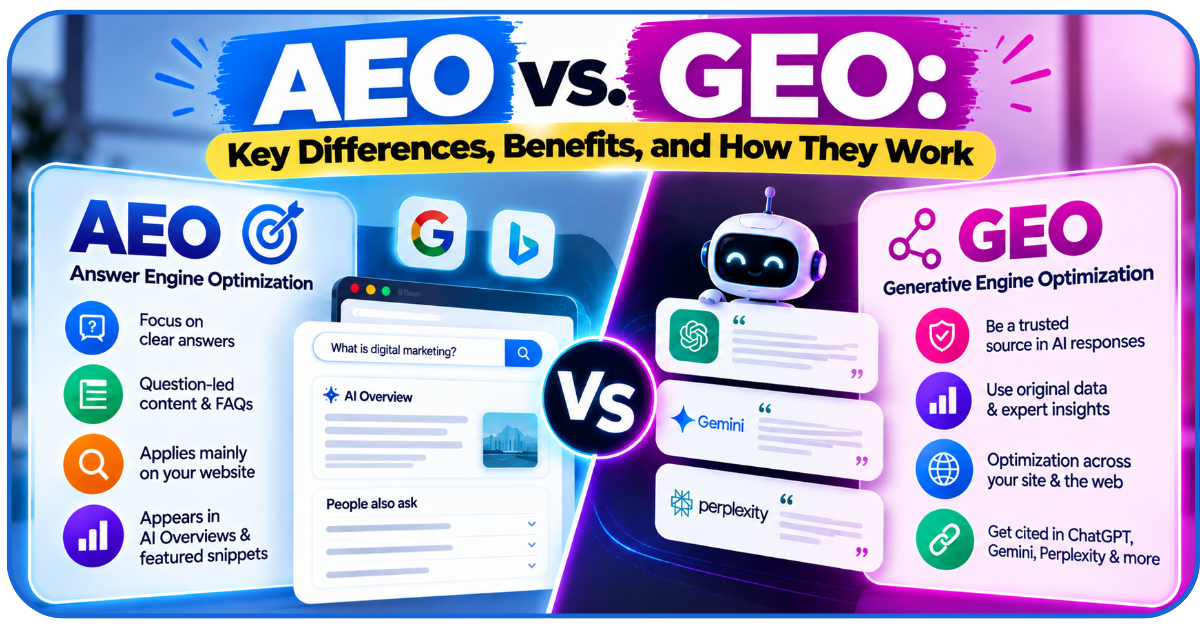
While they do overlap a lot in practice, there are some major differences:
| Comparison Point | AEO | GEO |
| Main Emphasis | Creating content with clear, extractable answers to specific questions | Being a trusted source inside a synthesized, multi-source AI response |
| Content Optimization Approach | Creating content pages with:
|
Creating content pages with:
|
| Potential Visibility |
|
|
| Where The Optimization Happens | Mostly on your own pages | On your pages and across the web:
|
| How to Measure It | Answer and AI-feature impressions | Share of AI responses that mention or cite you across many prompt runs |
| Typical Time to See Change | Can shift within days or weeks as pages are re-crawled |
|
| Shared Foundation |
|
|
Here’s how we sum up the core difference in the AEO vs. GEO debate:
- AEO concentrates on making sure your website’s content is full of relevant answers to relevant keywords and queries your target users have
- GEO does that and also considers whether your website has enough context, evidence, and overall online credibility to be included as a legitimate source in broader AI responses
The labels are working definitions; many marketers use them interchangeably, and the tactics overlap heavily. But this difference matters because it’ll define what you measure and where you invest — not because you’ll need separate teams to oversee each practice independently.
AEO vs GEO Examples: How Do They Work in Practice?
Here are two examples that show how AEO and GEO must work in conjunction:
Example 1: An Ecommerce Business
An online skincare store wants to be the answer to ‘How do I choose a moisturizer for oily skin?’
AEO Layer
- The page carries an H2 phrased as the question itself
- The H2 is followed by a 40-60 word direct answer — what to look for (e.g., light, non-comedogenic, oil-free), what to avoid (heavy occlusive, fragrance if you’re reactive)
- Below: short sections on texture, key ingredients, skin concerns, and related FAQs
GEO Layer
- A famous, licensed aesthetician weighs in with a reviewable quote
- A comparison table of ingredient types (niacin-amide vs hyaluronic acid vs salicylic acid) with claims attributed to dermatology sources
- Complete product data – size, full ingredient list, price, availability that matches what most retailers display
- Real customer reviews
Example 2: A Digital Marketing Agency
An agency publishes a guide to SEO services for small businesses.
AEO layer
- Each service is defined plainly — what’s included, who it suits, typical timelines, etc.
- There are question-led sections (‘what does an SEO service include?’) below
- Concise FAQs
GEO Layer
- Original insights from the agency that competitors can’t copy (like real lessons from the agency’s own engagements); supporting evidence
- The agency’s name, services, and location stated identically across the website
- Google Business Profile, LinkedIn, and review platforms linked across the site
As you can see from these AEO vs GEO examples:
- The AEO layer makes your answer easy to lift
- The GEO layer gives an engine a reason to trust you, include you, and recommend you
Both rest on clear, original, consistent, and SEO-optimized webpage structures.
How to Optimize Content for GEO and AEO
Since all AI engines are probabilistic, there’s no real guarantee that a website will be included in its answers or citations, no matter how well it’s optimized for SEO, GEO, or AEO.
The sensible thing to do is to start with optimization practices that benefit both readers and search visibility, then assess the results.
Answer Search Questions Directly
Use headings that describe the question or subject clearly. Put the main answer near the beginning of the relevant section, then explain the reasoning and exceptions. Use:
- Clear headings
- Concise answers
- Lists or tables when they genuinely make information easier to use
This doesn’t mean every page needs to be broken into tiny paragraphs. Google says there is no ideal page length and no requirement to ‘chunk’ content for AI.
Write sections that make sense on their own because they help readers. Not because an AI hack supposedly demands a fixed word count.
Build Credibility and Topical Authority
Generic summaries are easy to reproduce. Here’s what gives content greater weight
- Original research
- First-hand experience
- Transparent methodology
- Relevant expertise
- Attributed evidence
To give your content this type of weight:
- Publish genuine case studies
- Identify authors accurately
- Keep important facts current and earn reputable third-party coverage through real expertise
- Don’t manufacture reviews or mentions
- Don’t post AI slop
Use Structured Content and Relevant Schema
Clear headings, descriptive product information, useful comparisons, and properly organised sections help people and AI bots understand webpages.
Maintain Strong Technical SEO
Your content cannot be selected if the search systems’ AI engines cannot access it.
So, routinely check and optimize your website’s:
- Crawlability
- Indexability
- Internal links
- Mobile-usability
- JavaScript rendering
Maintain this order as you optimize your content for GEO and AEO:
- Create people-first content
- Build credibility
- Add structure
- Ensure optimal technical SEO health
But these tactics will only pay dividends when you tie them to your business goals.
AEO and GEO in Digital Marketing: Building a Unified Strategy
Think of these two as one foundation with two layers. The foundation is useful, non-commodity content that’s original, technically eligible, and valuable enough to be cited. Then,
- Layer 1 is answer-readiness (AEO)
- Layer 2 is source credibility (GEO)
Here’s how you can fit these layers of AEO and GEO in digital marketing plan:
Integrate AI Search Optimization with SEO
Retain all core SEO practices, like:
- Keyword research
- Creating new, helpful content consistently
- Internal linking
- Technical SEO
- Maintaining topical authority for specific high-value search terms
On top of these basics, also:
- Make sure your keyword research captures the longer, conversational questions your target users actually ask
- Check which pages earn/don’t earn impressions in Google’s AI Overviews and AI Mode on the Generative AI performance report in Search Console
- Keep investing in GEO & AEO until these scores improve
Connect Content Marketing with Brand Visibility
Map your content to the journey users take on AI engines:
- Create educational posts for early research (the queries with the heaviest AI Overview exposure)
- Create comparison and service pages for consideration
- Publish case studies and reviews for the decision
Align Optimization with Business Goals
Pair each goal with a metric:
- Awareness – mentions and share of AI answers
- Relevant traffic – AI referrals and branded search
- Leads and conversions pre- and post AEO/GEO-optimization – your internal revenue analytics
Keep checking and improving these metrics.
Conclusion
The buzz around AEO and GEO in digital marketing will only grow stronger as AI search replaces traditional search. If you think your website isn’t aligned with these practices – don’t panic.
Audit the pages that matter most. Do they answer real questions clearly? Do they offer more than generic summaries? Is the content easily extractable? Is it backed by evidence?
Fix those foundations gradually. And don’t go into the AEO vs GEO debate – thinking you’ll need to hire separate experts to do both. Your digital marketing department alone can handle both.
FAQs
Q1- How can businesses measure their visibility in AI-generated search results?
Start with Search Console’s free Generative AI report, which shows:
- Impressions by page
- Country
- Device
- No clicks or queries yet
Q2- How long does it take to see results from GEO and AEO optimization?
There’s no reliable timeline. Depends on:
- Your site’s authority
- The competition
- Content quality
- How often each AI engine retrieves/refreshes its index
Q3- Can small businesses compete with established brands in AI search?
Yes, though it’s harder where a few big names dominate.
Having a well-reviewed Google Business Profile helps.
Q4- Can AI-generated content improve GEO and AEO performance?
AI can help with research, outlines, and organization. But website content is far more likely to be picked up by AI engines if it’s original and full of new insights
Q5- Do businesses need specialized tools to implement GEO and AEO?
No. No third-party tools have access to Google, Claude, or OpenAI’s internal ranking systems. So avoid tools that promise to show you your website’s ‘AI engine rankings.’