

Even though the term ‘dough’ is casually used to refer to money, nobody dreams of opening a bakery because they love money. They dream of the smell of fresh sourdough at dawn, of baking crispy croissants every weekend, and of strangers becoming loyal customers.
These dreams are worth protecting, but the only way aspiring professional bakers can do so is to go for a concrete bakery business plan rooted in financial reality.
That’s because whether your bakery is successful or not doesn’t just depend on the quality of your baking skills. It depends on whether you have the right business model, repeat demand, the right pricing, reliable cash flows, and a slew of other financial and commercial factors.
And before you spend anything on ingredients, staff, equipment, or the store itself, you’ll need a bakery shop business plan that addresses these details. In this blog, we’ll show you how to create a fail-proof plan that’ll give your bakery business a long-term foundation for success.
What Is a Bakery Business Plan?
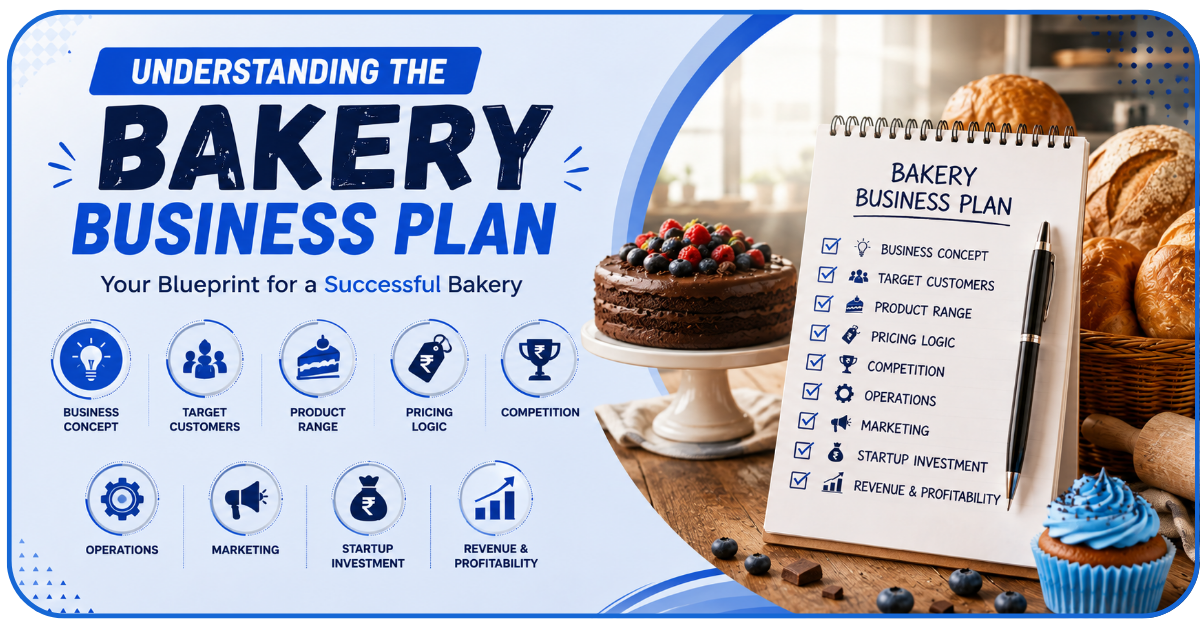
It’s a structured document that describes the:
🧠 Business Concept: What kind of bakery do you plan to build – a simple, low-capital home bakery, a high-capital bakery café, or something else?
🎯 Target Customers: Who are your ideal customers? Why do they need them, and why will they choose your baked goods?
🍰 Product Range: What products will you bake? How are they unique to what’s already out there? Which products will generate consistent revenue? Can you produce them consistently, at volume?
💶 Pricing Logic: How much revenue will the products generate after you factor in the costs of labour, ingredients, packaging, utilities, delivery, and waste? Are target customers willing to pay that price?
💪 Competition: Which bakeries are you competing with? How will your baked goods outcompete theirs? Which market gaps will your bakery business address?
📋 Operations: Do you have the equipment, skills, and systems to maintain a level of quality that lets you charge what you plan to charge? If not, how much capital will you need to address that?
📢Marketing: How will you market and sell the products? Via social media, delivery apps, or local contacts? Or at events via business contracts?
📈 Startup Investment: How much capital is needed to kickstart the business? How much is needed to run the business for the first 6 months? Who’ll provide the working capital and the startup capital?
📊 Revenue and Profitability: How much in sales do you expect to generate in the first 6 months? What market research, customer feedback, or test sales back up your projections?
Your bakery business plan must answer these questions and force you to test every assumption you have about starting the bakery — before it costs you any money or real effort.
Why Do You Need One?
Without a bakery shop business plan:
- Investors won’t provide the startup capital – because they’ll want assurances on how you plan to earn back the money they invest
- You won’t have clarity — even if you are self-funding a home kitchen or a small takeaway operation, you’ll need the financial clarity the bakery business plan provides
The plan will also tell you where you actually sit relative to your competitors and what you need to do to outcompete them and earn your target customers’ preference repeatedly.
Key Elements of a Bakery Business Plan
-
Executive Summary
At the top of your plan, there should be a paragraph summarizing your bakery’s:
- Concept
- Target customers
- Location
- USP
- Funding details/requirements
- Business goals
Here’s an example:
‘Crumb Cakes will run a 400 sq ft takeaway bakery in Location A. We’ll sell pastries and custom cakes to the families and working professionals who live nearby. We’ll produce X and Y amounts of pastries and cakes at a cost of $ and $ and sell them at $ and $ prices. Revenue targets are $ by next year, and X amount of funding will be required to launch. We plan to break-even by month 9.’
-
Business and Product Description
In the next section, describe in more detail:
- What you’re selling
- Why they’re worth selling
- Production costs
Here’s a framework for deciding which baked goods to sell:
- One specialty item that attracts foot traffic
- One profit-driver that’s fast and cheap to produce
- A premium signature item that has strong brand appeal
- Add–ons that pair naturally with the 3 products
-
Target Market and Competitor Analysis
Next, describe your customers. A standard bakery will target customers like:
- Working-age professionals who eat baked goods at breakfast or in the evening
- Parents who order custom birthday cakes
- Local cafés, restaurants, and hotels that need bread suppliers
Estimate how much demand you’ll get from these target customer groups based on their actual purchasing habits. You can find out about these habits by analyzing your closest competitors:
- Visit or buy from every competitor within your realistic service area (independent bakeries, major retail chains, and online businesses) at different times on different days
- Read their Google reviews to identify what actual customers are consistently unhappy about
- If multiple reviews across these bakeries mention dry products, items customers wish they could’ve bought, or issues like slow deliveries, you’ve spotted REAL MARKET GAPS
-
Marketing and Sales Strategy
What avenues will you market and sell your baked goods on? Some ‘must-target’ avenues include:
- Google Business Profile – free to create, easy to optimize, and build credibility with (just ask customers to leave good Google reviews) – should always appear when your bakery is Googled
- A strong local SEO strategy to attract customers every time they look up “bakery near me”
- Facebook and Instagram pages where you constantly share pictures and short-form videos and accept direct orders via DM
- Direct WhatsApp orders – a huge channel for direct orders in emerging markets
- Multiple direct order channels – your own website and, of course, the store itself
- Pop-up stores in local farmers’ markets, community events, and office gatherings
- Delivery marketplaces like Uber Eats that don’t charge exorbitant platform fees for your location and business type
You should also consider partnerships with local cafés, offices, and wedding vendors. Have a clear plan on how you want each of these channels to contribute to your bakery in terms of:
- Orders
- Average order value
- Repeat rate
Including these details (as long as they’re realistic) when creating a business plan for a bakery helps business leaders:
- Target the maximum number of relevant sales and marketing channels
- Focus on optimizing the most profitable sales channels early
-
Operations and Staffing
Next, describe how the bakery would actually operate day-to-day.
Walk through a realistic production day in writing:
- When do the baker and the rest of the team arrive?
- What is baked first, and why?
- Do you perform mixing/prep before dawn?
- How does order-proofing work?
- How are cooling and packaging handled?
- When does retail service begin and end?
- How often will you need to rotate stock?
- How much will you make from scratch, and how often will you use premixes, frozen dough, and pre-baked products?
Answer these questions and then create a schedule you expect to follow for your baker.
Most retail bakeries with a small production kitchen require, at minimum:
- 1-2 skilled bakers who handle the equipment and the actual baking work
- A counter person to facilitate orders, equipment maintenance, supplies, stock rotation, etc.
- The owner/manager in a hybrid role
Finding experienced bakers is genuinely difficult in most markets. Training takes time, and that’s a cost you should budget for if you don’t have one or two already in your team.
There’s also the question: are you the baker or the bakery operator?
If your skills sit firmly on the baking side, your plan needs to explain how the operational and financial management gaps get filled by a co-founder, a manager, or external advisors.
-
Financial Projections
Here, your plan can either become unrealistically optimistic or conservative to the point that you see no hope of making any profits. To avoid those extremes, build 3 versions of this section:
- A conservative case
- An expected case
- A stress case where sales are 30% below expected in the first quarter
Then, under each case, outline the following financial details:
- Startup budget: All one-time costs before opening
- Operating budget: Monthly expenses for the first 6 months
- Sales forecast: Product-level revenue projections
- Cost of goods sold: Ingredients, packaging, direct labour
- Fixed costs: Rent, utilities, insurance, marketing, loan payments
- Cash-flow forecast: When money comes in and goes out
- Profit and loss: Revenue minus all expenses per month
- Break-even analysis: When you expect total revenue to cover all costs
Create conservative, realistic, and stress cases for all of these figures.
Bakery Business Plan Investment: Where Will Your Money Go?
A business consultant might look at these sections of your plan and suggest that they can secure ‘X’ amount for your bakery. Now, the question is – once you secure that funding – where will it go?
Here’s how most professional bakeries spread out their funds. Use this chart to justify the way you allocate the funding you expect to receive:
| Investment Area | What It May Include | Planning Question |
| Premises | Deposit
Rent Renovation Fit-out |
Can this site support the sales needed?
Can projected sales justify this rent? |
| Equipment | Ovens
Mixers Proofers Refrigeration Display |
Does the cost of each item here match the $ you aim to generate based on validated demand? |
| Utilities, Infrastructure | Electrical upgrades
Gas Ventilation Drainage |
Can the site legally and safely support your production goals? |
| Ingredients (weekly or monthly) | Flour
Butter Eggs Chocolate Fillings |
How much do you need to stock before demand is proven?
How much stock will you need before you generate enough revenue to restock? |
| Packaging | Branded boxes
Bags Labels Inserts |
Does it protect the product?
Does it add to your brand? How are competitors handling this, and how can you cut costs here? |
| Licences
Professional fees |
Registrations
CA Legal Design |
Which of these costs are mandatory?
Which of them can you manage in-house? How do they vary by city, state, or locality, and can you cut costs by choosing a different location? |
| Staffing | Recruitment
Wages Training |
What must be staffed before day one?
How much will staffing cost in the first 6 months? How long will it take for the bakery’s revenues to cover all staffing costs? |
| Technology | POS
Website Ordering Accounting |
Which tools are necessary for the business to launch and operate?
Which tools will reduce errors or save labour? Which tools can you save money on? |
| Marketing | Branding
Photography Launch promotion on social media, local events, etc. |
How will the first hundred customers find you?
What will maximize your brand’s presence among relevant audiences? |
| Working Capital | Cash for the early months | How will you manage initial staffing, rent, and other costs if sales ramp slowly? |
| Contingency | Repairs
Delays Price rises |
How much flexibility does the plan need?
Do you have enough working capital to cover emergency scenarios? |
Add realistic figures to your bakery business plan investment based on:
- Market research
- Competitive research (learn what your closest competitors pay across these categories)
- Local supplier quotes.
- Local rent, labour, and regulatory compliance rates
Bakery Business Plan Cost: How Much Should You Budget?
There are two costs you need to budget for at first:
- First is your bakery business plan cost – which is the cost of creating this plan.
If you’re a very small, solopreneur business, this cost can be 0.
- Second is the plan activation cost – which refers to the cost of putting this plan into motion.
We’ve already discussed all the different costs you’ll need to account for — to kick-start your bakery business — in the previous section. These costs – and the investment opportunities you get from local banks or independent investors – will vary widely based on:
- If it’s a home or commercial bakery – with the latter requiring 6-figure investments or more
- Location – if it’s located in a busy, tier-1 city with validated demand – your cost will be higher, but so will be the number of investors lining up to back your bakery
- Size of premises – if the bakery’s physical footprint isn’t too big, even a small initial investment can kickstart a highly successful bakery business
- Equipment quality – if you already own most of the equipment, the cost will be low
- Number of employees – most bakeries start small, so don’t expect this to eat away too much of your initial funding, but you may need to hire more in busy seasons
- Menu size – you’ll need to start with a conservative menu with at least one traffic builder, one profit driver, and one premium product that makes your bakery stand out
- Interior requirements – this cost varies widely for cloud kitchens and delivery-focused bakeries vs. café or store-based business
- Delivery/online ordering – expect this cost to be around 20-30% of every unit you sell via this route
Common Mistakes to Avoid When Creating a Bakery Business Plan
While creating a plan, you should stay away from making these mistakes:
Treating Passion as Evidence of Demand
You can love baking and still open in the wrong location, sell at the wrong price points, and overestimate your customer base. Validation must come from the market, not from your own conviction.
Underestimating Startup and Working Capital
Most bakeries take 3-6 months to build stable revenue pipelines. Your startup fund must account for that period without assuming month-2 sales that have not been earned.
Forecasting From Capacity, Not Customer Behaviour
Knowing your oven can produce 200 loaves a day tells you nothing about whether 200 people will show up to buy them.
Adding Too Many Products Too Early
A wide menu will overwork your equipment, overburden your storage, overcomplicate your sourcing, and dilute your staff’s attention across too many moving parts simultaneously.
Signing a Lease Before Checking Infrastructure
Before you rent a location for your bakery, check its:
- Electrical load capacity
- Gas access
- Ventilation permissions
- Drainage facilities
If these infrastructural aspects aren’t bakery-friendly – AVOID!
Copying Competitors’ Pricing
Price every unit in your catalog based on that unit’s:
- Ingredient costs
- Packaging costs
- Labour costs
- Marketing costs
- Cost of all utilities used to make the unit
- Waste generated and managed while making that unit
It doesn’t matter if this sum doesn’t match what your competitors charge.
Forgetting Marketing Costs
Running local SEO campaigns will cost you a lot. So will managing a strong social media presence. Budget for these marketing costs and factor them in while pricing your baked goods.
Not Calculating Break-Even
When will the bakery pay off everything you invested in it? All investors want to see this in the bakery business plan, so don’t leave out this calculation.
Conclusion
A bakery is a fun but difficult business to run.
The emotional appeal for baking connoisseurs is real. The creative satisfaction of cooking up fresh batches of bread, croissants, and pastries is incredible. But the commercial reward?
That’ll only come if you have a strong bakery business plan.
Hopefully, this guide helps you create a plan of appropriate strength for your dream bakery.
Start by answering who the bakery is for, and why they will keep coming back to it.
Build the plan from those answers outward.
Update your bakery shop business plan every time reality contradicts an assumption. That discipline is what’ll help your bakery earn dough and not just make it.
FAQs
Q1- Can I create a bakery business plan without any business experience?
Yes. You can use templates other solopreneurs have shared online.
You can also perform market research for free on Google. But to get the financial aspects of your plan right – we recommend you seek out some degree of professional guidance.
Q2- What financial ratios should I track after opening a bakery?
Some must-know and must-track financial metrics include food-cost percentage, labour-cost percentage, gross margin, average order value, and repeat-purchase rate.
Q3- How often should a bakery business plan be updated?
Every month, based on the bakery’s key operational metrics. After every financial quarter – based on its financial performance. And, annually, for a detailed analysis of sales, costs, customer preferences, and growth plans.
Q4- Can AI help me create a bakery business plan?
Yes, AI can help with:
- Building a structured outline
- Generating customer persona frameworks
- Organizing competitor research
- Drafting marketing copy
- Structuring a financial model template
- Stress-testing scenario planning
Q5- Should a bakery business plan include a wholesale or catering strategy?
Yes. Your plan should ideally involve as many potential revenue sources as possible.
But only if you have real plans and contacts that can help build those wholesale accounts, corporate orders, or event catering arrangements.