
In 2023, NHS England signed a 7-year, £330 million deal with Palantir to run its new Federated Data Platform. The next year the same company landed a 5-year contract with the US Army worth up to $480 million. Last year, the US government raised that contract value up to $1.3 billion.
These headlines and numbers make software firms across the world think, ‘Why don’t we learn how to sell software technology to the government?’ But selling to the government isn’t as simple as selling software to B2B firms or individual consumers.
Firms like Palantir keep landing multi-million-dollar government contracts because they constantly put out content that positions them as the de facto leader in government-grade technology. Of course, they’re also masters at building government contacts, anticipating government needs, applying for contracts at the right time, and all the other technical aspects of this world.
How can your software firm build all of these capabilities? By following this 10-step strategy to sell technology to the government. We’ll walk you through all the procurement rules, compliance checks, security reviews, and budgeting processes your firm will need to complete.
And we’ll show you how showing up in the searches and LinkedIn feeds of government officials can drastically improve your chances of securing the big contracts.
How to Sell Software Technology to the Government: What Software Firms Must Know
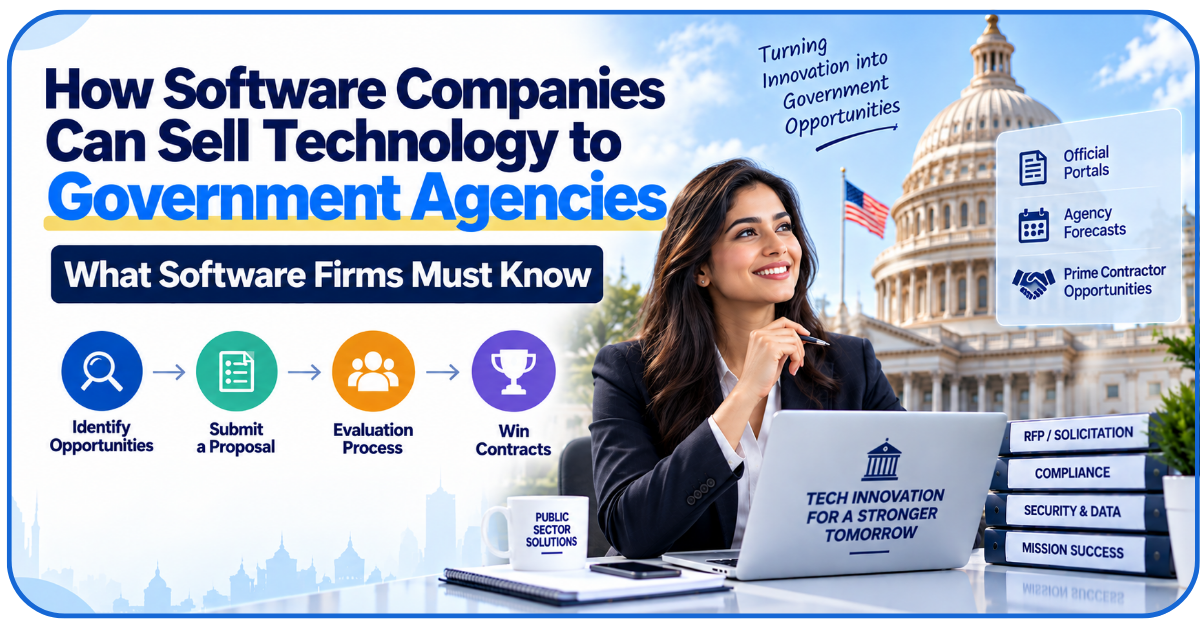
Government contracts usually appear in one of a few places:
- A formal solicitation on an official portal (like SAM.gov for the US or Canada-Buys for Canada)
- An agency’s acquisition forecast where they lay out what software they plan to buy
- A subcontracting opportunity from a prime contractor
Here’s how the process works in a nutshell:
- A software company spots a government need (through a posted solicitation, tips from partners, etc.)
- It responds formally with a bid
- The bid is evaluated alongside other bidders
- During the evaluation, the bidder with the strongest pre-existing reputation for knowing what the government needs, or being a thought leader in the space, wins
If you’re a new and inexperienced software firm fretting that you’ll lose out by stage IV – don’t worry. We’ll show you how to sell software technology in a way that helps you succeed in all the stages.
And don’t forget – even before the evaluation phase, mistakes like a missed registration deadline or a poorly worded pitch can cost you dearly. So, let’s cover some of these technical aspects first.
1. Understand the Government Agency’s Needs
In the early 2010s, the Centers for Medicare and Medicaid Services (CMS) gave a $90 million contract to Canadian software firm CGI Federal – asking them to build their website, HealthCare.gov. That site crashed on launch, couldn’t handle concurrent users, and had to be rescued by another crew of engineers.
When asked why they failed, CGI stated it didn’t have the same understanding of its role that CMS assumed. The lesson here is that software firms must deeply understand the government agency’s needs and problems — before proposing any solutions. They must:
Diagnose the Agency’s Operational Needs
When you identify a potential opportunity to sell software to the government, ask questions about what problems your software should ideally solve:
- What task is slow, expensive, or risky that your software should optimize?
- What systems are currently involved?
- Is the agency looking for a software product, recurring services, modernization, or integration?
- Which employees or citizens will the software serve?
Start by diagnosing the actual failure points in the current system the agency uses. Then shape your software solution around the government workers who’ll use it routinely and the citizens it’ll serve.
Different Agencies Trust Different Kinds of Software
A health agency will prioritize software that delivers accuracy and privacy over flashy automation. A court system will prefer auditable, rules-based software tools it can explain in hearings.
Defense agencies care about secure deployment and interoperability. City permitting offices care about speed and staff time. Keep these types of details in mind.
Existing Technology Sets the Boundaries
Use the agency’s IT strategy pages, budget-related publications, general reports, and prior solicitations to understand what types of technologies the organization currently uses.
Software that requires ripping out an agency’s core systems is a much harder sell than one that plugs into what’s already there.
Research before You Pitch
Research the agencies and their current software vendors before building a proposal:
- Learn what agencies already buy your type of software
- Find out who currently holds contracts, when they expire, and other related details
Find as much info as you can about what software the agency actually needs and currently uses by scouring through relevant:
- Government websites
- Procurement portals
- Public reports
- Agency announcements
- Industry publications
2. Learn How Government Procurement Works
Most government software purchases have to go through some form of open competition. The agencies publish two types of documents in the following order to invite competition:
- A Request for Information (RFI)
- A formal Request for Proposal (RFP)
Here’s how software firms should respond to these documents:
- Respond to the public RFI with a direct, useful answer (not a sales deck)
- Receive the RFP, which will spell out what the agency wants and how software firms will be scored
- Send an official proposal to the RFP answering every technical requirement
But, long before you draft a proposal, you need to ensure your firm:
- Is registered to be eligible for government work (Indian software firms can register via the GeM or CPPP websites)
- Has the right certifications to handle federal or controlled information
- Has all the necessary compliance documentation, including a capability statement, security certifications, past-performance references, and whatever else the solicitation asks for
Map out the stakeholder chain early. Find out who will occupy these roles:
- Program owners/managers
- CIOs
- IT leads
- Security officers, procurement officials, legal staff
- End-users (govt. workers) who’ll use the product
Find out what documents, certifications, and explanations each of these stakeholders needs.
Also, in your RFI response, ask whether the agency has the budget to support the software they’re commissioning. You can’t sell technology to the government if they can’t afford what you’re building.
All of this will take months, so plan around a long sales cycle.
Most government buyers spend months quietly researching before anyone from their agency reaches out to a vendor — reading guides, comparing options, even browsing Reddit. The more good content is available, the more each stakeholder, from a budget-holder to a technical lead, can form an informed opinion on the software firm.
3. Build a Strong Value Proposition
The first thing developers notice when they learn how to sell software technology is that the average user rarely cares about long, technical lists of features.
The government operates in a similar way.
Yes, you may have to share technical documents and explainers with the agency’s IT leads.
But most of the stakeholders who’ll review your proposal won’t know or care enough to scrutinize your software’s feature list. They only want solid evidence that your product solves the mission requirement and is affordable, secure, and compliant.
So, make sure your initial pitch answers questions like:
- What problem does it solve?
- How much time can it save?
- Is it secure?
- Can it reduce costs?
- How does it improve service delivery?
- How does it boost completion rates, wait times, or satisfaction scores?
- Can it integrate with the agency’s existing tech and support its future goals?
4. Establish Trust and Credibility
A government buyer isn’t just betting on your software working — they’re betting if your firm will:
- Still be around to support it in 3-years
- Pass all recurring security reviews
- Offer long-term assistance and expert guidance on all things software-related
Content that addresses these worries long before anyone has to ask has to be an essential pillar of all selling strategies to the government. When a procurement officer finds your website, they should see evidence that your firm understands their world. This evidence can be in the form of:
📋 Case studies explaining past work with implementation timelines and clear outcomes
📑 Posts discussing the certifications and security credentials your firm has earned
👨💻 Explainer articles demonstrating key aspects of your software solutions
🎓 Opinion pieces discussing major advancements in relevant fields
Check out how companies that already sell software to the government use content marketing to build authority, like:
- Tyler Technologies, which serves local governments – publishes podcasts, case studies, and public-sector data-governance guidance
- Granicus, which serves 7000+ public-sector organizations – publishes content on permit processing and civic digital engagement
Team up with content specialists to emulate (and eventually outperform) such industry veterans.
5. Use SEO to Get Your Technology in Front of Government Buyers
You can’t learn how to sell software technology to a government agency until you learn how these buyers actually search for software solutions. Government staff, like everyone else, use Google (and AI tools these days) and professional networks like LinkedIn to:
- Research software firms that discuss selling the solutions they need
- Determine which firms qualify for their security and compliance requirements
- Compare vendors and products
They search for terms like:
- ‘Government cybersecurity software’
- ‘Public-sector automation’
- ‘AI for government agencies’
- ‘Government workflow software’
Your software firm’s website must be full of content targeting these types of keywords.
That means you need to:
- Perform keyword research to confirm the search volume for all relevant keywords in your niche
- Learn what most searchers want (comparisons, how-to guides, etc.)
- Create different pieces of content for all relevant keywords
- Create landing pages around specific queries customers have
2-3 posts a year won’t help you sell software to the government. Publish high-value content consistently so that your firm always ends up in the shortlists buyers create after researching online.
6. Create Content for Different Government Decision-Makers
A single software purchase can involve 5-6 different government professionals, and they won’t be reading the same page:
- IT staff will want to read technical guides discussing your software’s architecture and integration details
- Procurement teams will want blogs and case studies discussing pricing, terms, and proof of past performance
- Senior govt. officials will want to see opinion pieces presenting your digital strategies to the government and case studies demonstrating your software’s ROI
- Security teams will want articles specifying the firm’s compliance, data handling capabilities, and incident response plans
Create all of these types of content and optimize them to create a strong lead funnel, like:
- Awareness (basic blog posts discussing industry news, your product, govt.’s digital needs, etc.)
- Deeper interest (in-depth technical guides that demonstrate your expertise)
- Proof (case studies)
- Proposal (long articles showing how your software solves the govt. agency’s specific problems)
Such a funnel of diverse content will make choosing your firm feel safer to government workers.
7. Use LinkedIn and Thought Leadership
LinkedIn is one of the few platforms where private and public procurement officers and agency executives frequently communicate. Target this platform extensively:
- Optimize your company and executive profiles around your firm’s actual capabilities
- Use the same terminology current government contractors use
- Include your contract vehicles, past performance, and security credentials in your bio
- Publish practical content (not generic motivational posts) every day
- Share case studies, implementation lessons, and agency-mission insights
- Comment thoughtfully on public-sector technology developments
- Host webinars to bring together former government agency leaders, security specialists, and implementation experts
Demonstrate your firm’s expertise and understanding of government challenges on LinkedIn. It’ll further your brand’s status and earn you indirect leads.
8. Prepare a Government-Focused Sales Funnel
When members of your firm learn how to sell software technology to the government, make sure they all read from the same book – especially marketing and sales.
Here’s how they should learn and work together to create a government-focused sales funnel:
- SEO or content brings a government official to your site’s landing page
- A lead magnet (guides, checklists) instantly earns their contact details
- Fast email responses from your sales team pay special attention to their needs
- You quickly ask to host a consultation or demo to answer their specific questions
That’s how you can maximize your proposals’ chances of turning into long-term contracts. To keep every potential govt. lead’s journey across the funnel engaging:
- Use CTAs that match the buyer’s stage
- Keep lead forms short
- Email campaigns should be fast, cordial, educational (but not aggressive)
- Score all leads based on strategic fit and communicate with them accordingly
Make sure to have a CRM in place to track the agencies you’re targeting as well.
9. Measure and Improve Your Strategy
Track metrics that reflect how well your content marketing and outreach efforts are performing.
On the marketing side, monitor metrics like:
- Organic traffic from public-sector audiences
- SEO rankings for government-specific queries
- Engagement with technical and security pages
- Downloads of capability statements
On the sales side, track:
- How many qualified government leads you’ve contacted in a specific time period
- How many agency meetings you’ve set up
- How many RFI responses you’ve received
- Proposal submission rates
- Contract win rates (your agency vs. competing software firms)
Investing in digital marketing means you’ll get plenty of early warnings on whether your selling strategies to the government are actually working.
Rising interest in a specific term or a monthly surge in downloads of technical documents will tell you if you’re on the govt.’s radar at all – long before they reach out or respond to your proposals.
So, keep improving these metrics every quarter.
10. Avoid these Common Mistakes When You Sell Software to the Government
These mistakes are a big NO-NO.
| 🚩Ignoring the Govt. Procurement Process | Treating government sales like conventional B2B sales may result in your firm having conversations with ‘officials’ who aren’t authorized to buy stuff, or you submitting lengthy proposals on the wrong channels. Always identify the right procurement routes, confirm whether a real solicitation exists, and follow all submission instructions exactly. |
| 🚩Focusing Too Much on Features | Connect every feature you mention in your proposals to specific workflows. Explain how they’ll combine to make the lives of government professionals and citizens easier. |
| 🚩Overlooking Compliance and Security | A software firm without the right compliance certifications and security credentials can NEVER sell software to the government. Perform a GAP assessment to check if you meet these standards before you start drafting proposals. |
| 🚩Using Generic Marketing Content | Low-quality, generic content won’t bring your site any leads. It may even deter government officials from contacting you. Invest in high-quality content marketing to ensure the government sees your brand as industry-leading. |
| 🚩Neglecting SEO and Online Visibility | A vendor with no useful website, security information, or case studies will be excluded in the research process. |
| 🚩Expecting Quick Conversions | Once you learn how to sell software technology to the government. and implement all of our guidelines, don’t expect a flurry of leads to come in 7-8 months later. It can take years for these seeds to bear fruit. Be patient and keep building your reputation. |
| 🚩Not Nurturing Leads | A government buyer may ‘disappear’ if their funding gets delayed. Keep updating them during these wait periods as you wait for the next fiscal year. Let them know your software is ready-for-deployment. But don’t irritate them with too many generic sales pitches. |
Conclusion
Learning how to sell software technology won’t do you any good if your firm doesn’t have the right certifications or the right reputation.
So, start collecting the right accreditations and building a strong digital presence right away.
The best way to sell technology to the government is to have them reach out to you. Create an SEO and content profile that makes that scenario inevitable!
FAQs
Q1- How long does it typically take to sell software to a government agency?
Depends on the agency and the contract’s size. Small local deals can be finalized in months. Larger national contracts can take years.
Q2- Do small software companies have a chance of winning government contracts?
If they’re specialists at building specific types of software and have the right reputation, yes.
Q3- What certifications can help a software company become more attractive to government buyers?
Depends on the country and the contract.
Research the exact security and compliance requirements that apply to your target polities.
Q4- Can AI help firms sell software to government agencies?
It can only help with research, content writing, and proposal drafting.
Q5- Should government technology companies invest in paid advertising?
Only for high-intent, specialized searches and as a complement to organic SEO, not a replacement.