

Approving loans, verifying employee IDs, or clearing supplier invoices should all be simple, routine business tasks. But today, most of these documents are submitted and processed online — and fraudsters, with the help of AI, have professionalized the art of manipulating them.
They now use professional templates, cutting-edge PDF and image-manipulation tools, and generative AI to produce fraudulent documents that appear 100% authentic.
They’ll manipulate PDF bank statements to trick businesses into wiring money to the wrong address. Or, use AI image editors to fabricate pay stubs with inflated incomes to misdirect payment transfers.
Roughly 1 in 16 documents processed by fraud-detection networks last year were near-flawless fakes like these. The human eye simply cannot identify such pixel-perfect forgeries.
Even the basic OCR and document-management systems that countless businesses currently use struggle against these rapidly-evolving and increasingly sophisticated threats.
The solution? Using a new generation of automated document fraud detection software. Here’s why these tools are essential for any business that processes large volumes of documents.
What is Document Fraud Detection Software?
It’s a specialized security software engineered to analyze whether the submitted documents are genuine, altered, fabricated, or inconsistent with the transaction/s they’re supposed to facilitate.
They’re not the same as basic OCR and document verification software. The document verification tools that are often embedded in business or project management tools only check basic details like:
- Are all the necessary fields/boxes filled in this identity document?
- Is this document expired?
OCR systems only check for details like:
- Is this document readable?
- Does the document have the right format?
A specialized document fraud detection software will probe deeper and dig into the invisible architecture of the document to check for details like:
- Has any region of the document been digitally altered?
- Do the transaction totals actually reconcile?
- Does the file’s metadata match the claimed source?
- Are all the pixel alignments in the file mathematically feasible?
- Does the file contain any hidden software signatures?
The best fraud detection software tools are powered by their own machine learning models. And since different documents carry different fraud signals, these models are trained (and routinely updated) on the specific documents that are frequently manipulated by the fraudsters, like:
📄 Fake identity documents (passports, driver’s licenses, etc.) with altered names, dates, addresses, or photos to facilitate synthetic identity fraud (increased by 495% this year) or account takeovers
📜 Forged certificates like false medical credentials or academic diplomas fabricated to bypass high-stakes recruitment screening
💳 Manipulated invoices with fake vendor details swapped into legitimate templates to steal corporate payouts
🏦 Altered bank statements with account totals inflated to secure unmerited mortgages or corporate loans – a leading cause of identity theft
💼Counterfeit business documents used to build shell companies for money laundering
Each document type requires a different detection strategy.
Why Businesses Need Automated Document Fraud Detection
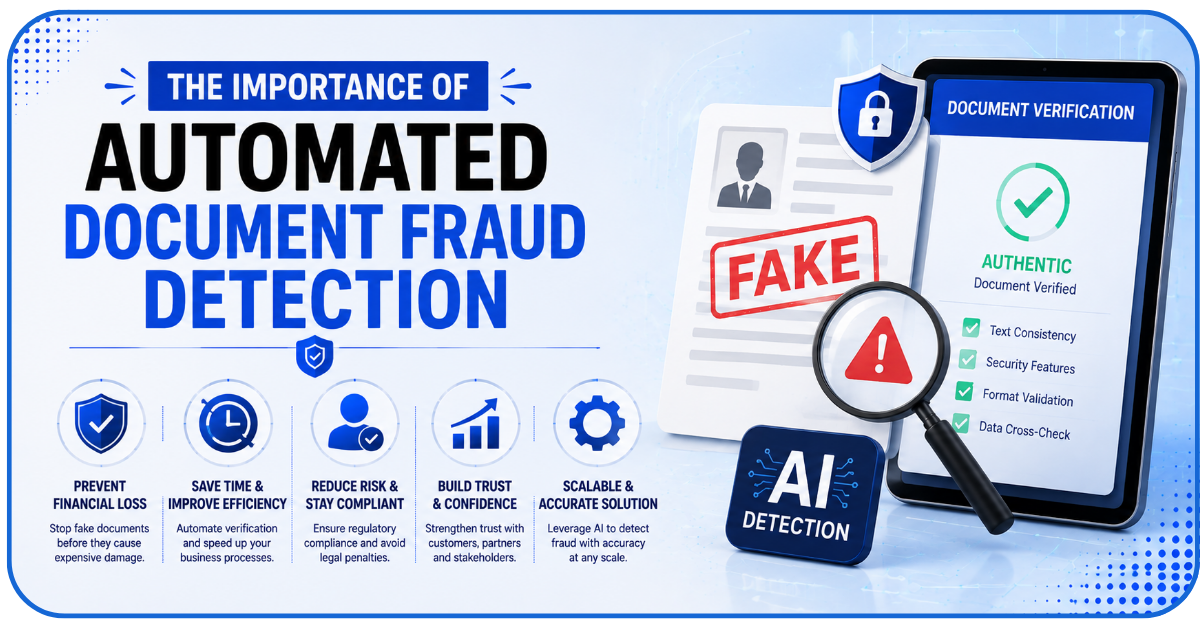
Manual document review is structurally incapable of keeping pace with the volume and sophistication of modern document fraud, because of:
⚠️ Inevitable Human Errors: Asking human reviewers to process hundreds of files daily and spot minor inconsistencies like one changed amount in a 10-page bank statement is unfair
🐌 Slow Verification: A thorough human review may require contacting employers to verify pay stubs or waiting for underwriters to review their PDFs — too slow and cumbersome
📂 Increasing Document Volumes: Most business and customer documents (invoices, KYC forms, etc.) are submitted online today — how many can human reviewers verify in a day?
😈 Sophisticated Manipulation: Fraudsters today will buy authentic bank statement templates on the dark web and then alter just 1-2 fields; or they’ll generate entirely synthetic files with AI. Visual human checks are useless against fraud like this that preserves the document’s overall appearance.
📈 Unfeasible Operational Costs: Maintaining a massive manual review team requires heavy training, QA overhead, and constant rework
🚨Customer Experience Risk: Legitimate customers forced to wait 48 hours for a human to review their ID will simply abandon the process and go to a competitor
The only defence against this new era of document fraud is automated document fraud detection software. Even legacy OCR tools will read and extract a ‘balance’ from a bank statement PDF and completely miss the fact that the number was fraudulently inserted using the latest PDF editor.
If a business blocks a known PDF template? Fraudsters will modify the spacing or metadata in their future files. If a business checks only screenshots? Attackers will submit higher-quality images.
Automated document fraud detection software combines multiple detection layers to track these minute details. More importantly, they’re routinely updated as new fraud patterns emerge.
How Document Fraud Detection Software Works
Here’s how they work.
Document Upload and Image Analysis
After a customer or vendor uploads a document through a web form, app, or API, the software instantly analyses:
- Whether the document is a PDF, a scan, a photograph, a screenshot, or digitally generated
- The document’s resolution, focus, lighting, orientation, and page-completeness
- The PDF structure, which objects are embedded in it, its metadata, what software was used to create it, all hidden timestamps, and its revision history
- All image regions for cloning, splicing, inconsistent compression, or unusual pixel patterns
If a document claims to be a freshly downloaded bank statement but the metadata shows it was exported from Adobe Illustrator an hour ago, the software triggers an immediate red flag.
Data Extraction and Verification
Once the file structure is validated, the document fraud detection software extracts every bit of data in the document, including all:
- Names
- Dates
- Account numbers
- Addresses
- Employer information
- Income figures
- Business registration details
- Balances
- Invoice line items
- Payment details
These details are then checked against the software’s up-to-date Natural Language Processing and Large Language Models (LLMs). The software will spot the minutest data inaccuracy at this stage.
If there are no direct data inaccuracies, the software will then perform logical reconciliation:
- If a pay stub shows a gross income of $5000 and deductions of $1000, but the net pay reads $4500, the system’s mathematical engine will instantly flag the arithmetic illogicality
- Bank statements will be checked for historical balance continuities
- Invoices will be compared with past purchase orders and other records
Fraud Pattern Detection
The software then deploys computer vision and deep learning models to spot anomalies and signs of manipulation, like:
- Changed Amount Fields: The software detects if a specific number or field has a different compression artefact or pixel noise level than the surrounding text
- Pasted Signatures: It analyses the document’s background textures to confirm if a signature was cleanly copied and pasted from a different file
- Altered Dates and Fonts: Scans the embedded font dictionaries — if an issuer uses Helvetica, but a specific date is rendered in a slightly different font weight/spacing, the system catches it
- AI-Generated Documents: It deploys cutting-edge algorithms to identify if the rendering signatures and layout inconsistencies in the file match common synthetic, AI-generated fakes
Database and Identity Checks
A document can be forensically flawless, but still contain stolen data.
To combat this risk, a top automated document fraud detection software will cross-reference the extracted data against external up-to-date truth sources, like:
- Government identity databases
- Credit-bureau sources
- Employer verification databases
- Company registries
- Sanctions lists
- Internal customer records
If a fraudster uses the same digital template to attack a bank in London and a lender in Tokyo, the software will spot that underlying digital fingerprint and block the second attempt instantly.
Risk Scoring and Alerts
Instead of providing a rigid ‘yes or no,’ the latest document fraud detection software tools assign calculated risk scores (typically 0-100) to each file:
✅Low-risk, verified documents are given higher scores and auto-approved
🚩High-risk documents are flagged with low scores and specific reason codes like ‘Inconsistent metadata’ or ‘Font mismatch on line 4’
So, after the software has cleared the large volume of routine, legitimate submissions, trained human reviewers can focus on the smaller queue of suspicious documents.
Key Features to Look for in the Best Fraud Detection Software
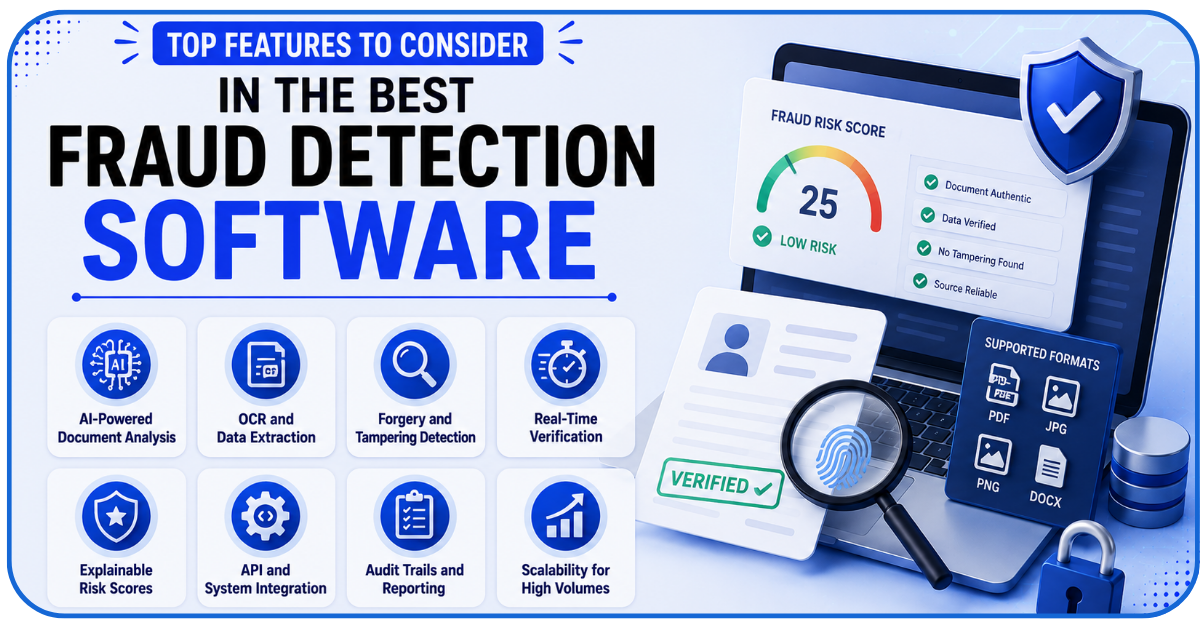
Now you may think that the vendor or customer documents your business processes don’t need to undergo so many levels of authentication. But a cheap, lower-quality tool will cost you exponentially more in compliance fines and stolen funds.
To truly protect your business and customers, you must prioritize selecting a document fraud detection software that offers:
🧠 AI-Powered Document Analysis: The best tools proactively update their AI models with the latest forgery patterns/strategies to protect businesses against tomorrow’s threats
🤖 OCR and Data Extraction: The software must be lightning-fast in extracting data from big multi-page documents with complex layouts across multiple languages — without losing the relational context of the data
🕵️ Forgery and Tampering Detection: The system must perform pixel-level manipulation detection, hidden software signature extraction, PDF metadata detection, abnormal-font analysis, revision-history inspection, and all the other checks we discussed above
✪ Real-Time Verification: The best fraud detection software can perform multi-step forensic analyses and process all types of documents (PDFs, screenshots, etc.) against prebuilt templates, AI and LLM models, and external databases in under 8 seconds
🥇 Explainable Risk Scores: Scores must come with explainable reason codes attached to every flagged anomaly
🔌API and System Integration: It must connect cleanly with your CRM, onboarding flows, insurance-claims systems, ERP tools, or applicant tracking systems via robust APIs, SDKs, or webhooks
🔒Audit Trails and Reporting: Its audit records should show every submitted file, every extraction result, every check performed, every signal generated, and every reviewer action with timestamps — this’ll support your compliance needs, appeals, internal investigations, and regulator requests
📈 Scalability: The best fraud detection software tools don’t crash when they have to handle 10x surges in document uploads during busy tax or recruitment periods — they auto-scale without overcharging
Benefits of Using Document Fraud Detection Software
Creating a fraud detection layer with this type of software to screen every document you receive from customers or vendors means:
- Faster Verification: You can process your vendors’ or business partners’ documents in seconds, not weeks, and get more work done
- Reduced Fraud Losses: They’ll protect their balance sheet against synthetic bank statements, forged invoices, false loan defaults, vendor theft, and all other types of document-based identity fraud
- Lower Manual Workload: Using document fraud detection software means not having to hire a team of manual reviewers – you’ll only need a few trained analysts
- Improved Compliance: Ironclad audit trails and automated identity checks will insulate the business against KYC, AML, and regulatory fines
- Better Customer Experience: Legitimate users will breeze through onboarding with zero friction, which will boost your firm’s customer satisfaction rates
- Consistent Verification Decisions: Every document will be judged by the same mathematical standards, which will reduce inconsistencies and biases and make policies easier to audit
- Easier Scalability: The best fraud detection software will let you 10x your customer acquisition or business transaction volumes — without having to increase your compliance workforce
Who Can Benefit From Document Fraud Detection Software?
Any organisation that routinely receives large volumes of documents can benefit from using these tools. These include:
- Banks and financial institutions can protect their account opening, lending, KYC, and KYB workflows against the rising threat of document fraud
- Insurance companies can verify claims faster, spot fake medical records, make more accurate repair estimates, and validate their clients’ income documents during underwriting more effectively
- Fintech companies can ensure 100% fraud prevention while onboarding their users digitally or while verifying payments
- E-commerce businesses can validate the certificates, business documents, and identity records of the vendors aiming to sell via their platforms
- Government organizations can use the latest document verification technology to process all the documents citizens send in when applying for applications, licenses, benefits, and permits.
- Healthcare organizations can verify patients’ identities and insurance records and their workers’ licenses and referral documents
- Recruitment teams can validate their candidates’ IDs, degrees, certificates, and employment records with digital document verification and totally eliminate the risk of hiring frauds
- Real estate professionals can review their renters’ applications, pay stubs, bank statements, and ownership records
- Lending platforms can verify income, asset, tax, and employment documents when underwriting loans for applicants
How to Choose the Right Document Fraud Detection Solution
Don’t rush to sign up for a software provider right after you receive a free sales demonstration. Instead, take note of the following:
- Detection Accuracy: Test multiple tools with a mix of clean documents, forgeries, and AI-generated fakes — measure which ones have the best false-positive and false-negative rates
- Supported Document Types: Make sure the tool you select supports the exact documents (bank statement PDFs, invoice images, etc.) you process globally, not just US-based file templates
- Integration Capabilities: Verify that the document fraud detection software integrates cleanly into your current ERP, CRM, and other document-handling tools
- Processing Speed: Test how fast the software processes multi-page documents and low-resolution mobile uploads during peak hours – including external checks and human reviews
- AI and Machine-Learning Capabilities: Only choose automated document fraud detection software that routinely updates its threat intelligence
- Security and Privacy: The software must have strict data residency controls, full SOC 2 compliance, and strong data encryption
- Scalability: Confirm if their cloud can handle big spikes in concurrent API calls or if they have throughput limits, regional availability issues, uptime limits, or extra costs at higher volumes
- Reporting: The dashboard must track all fraud alerts, decisions, and reviewer actions with timestamps and complete audit trails
- Pricing: Compare the total cost of ownership, per-document fees, minimum commitments, manual-review charges, storage fees, and implementation costs
- Customer Support: Do the software makers provide friendly onboarding assistance and integration assistance? Do they respond to incidents rapidly?
Ultimately, the software you choose must be able to deal with:
- The volume of documents your business routinely deals with
- Address the risk profiles your documents typically face
High-volume businesses will need software that facilitates bulk-processing and automated routing.
High-risk financial firms will need software that offers in-depth forensic analyses and rapid tracking with external databases.
Conclusion
Manual reviews and standard extraction and rules-based tools are useless in this new era of dark web and AI-powered identity fraud.
Only specialized document fraud detection software tools that combine deep image forensics, network-level threat intelligence, and automation can tackle this new generation of threats.
Hopefully, this guide inspires you to safeguard your company’s ability to process documents safely by switching to these new-gen tools.
FAQs
Q1- Can document fraud detection software detect documents created with Deepfake technology?
Yes. They do this by tracking:
- Microscopic pixel anomalies
- Metadata inconsistencies
- Hidden artefacts Deepfake image generators leave behind
Q2- How does AI improve document fraud detection?
With AI, these tools can analyse thousands of:
- Hidden visual anomalies (like inconsistent shadows)
- Textual anomalies (subtle font kerning mismatches)
- Structural anomalies
Traditional rules-based detection software can’t perform such in-depth, large-scale adaptive learning.
Q3- Can document fraud detection software work with documents in different languages?
Yes. The best fraud detection software tools can process documents in 50+ languages.
Check if the software you want to use supports your preferred language/script.
Q4- Does document fraud detection software replace human verification teams?
No. By auto-approving legitimate documents and quickly flagging fakes, it lets human verification teams investigate the fakes better so that they’re better prepared against future threats.
Q5- How long does it take to implement document fraud detection software?
Depends on how many API integrations you’re making, how many document types planning to routinely process, and how long your staff takes to learn the tool. Prepare for a multi-week pilot rollout. Most teams become acclimatized to using these tools within 30-90 days.