

Banks have always been slow to change. But something is different this time. In the past two years, generative AI in banking has moved from a boardroom talking point to an operational reality. Lenders are using it to detect fraud in real time. Wealth managers are deploying AI-powered banking solutions to generate personalised client reports in seconds. Customer-facing chatbots now handle queries that used to require trained agents.
The shift is already underway, and banks that ignore it risk falling behind those that don’t. This post breaks down what generative AI actually does in financial services, where it creates real value, what risks to take seriously, and where the technology is headed next.
Why Banks Are Paying Attention Now
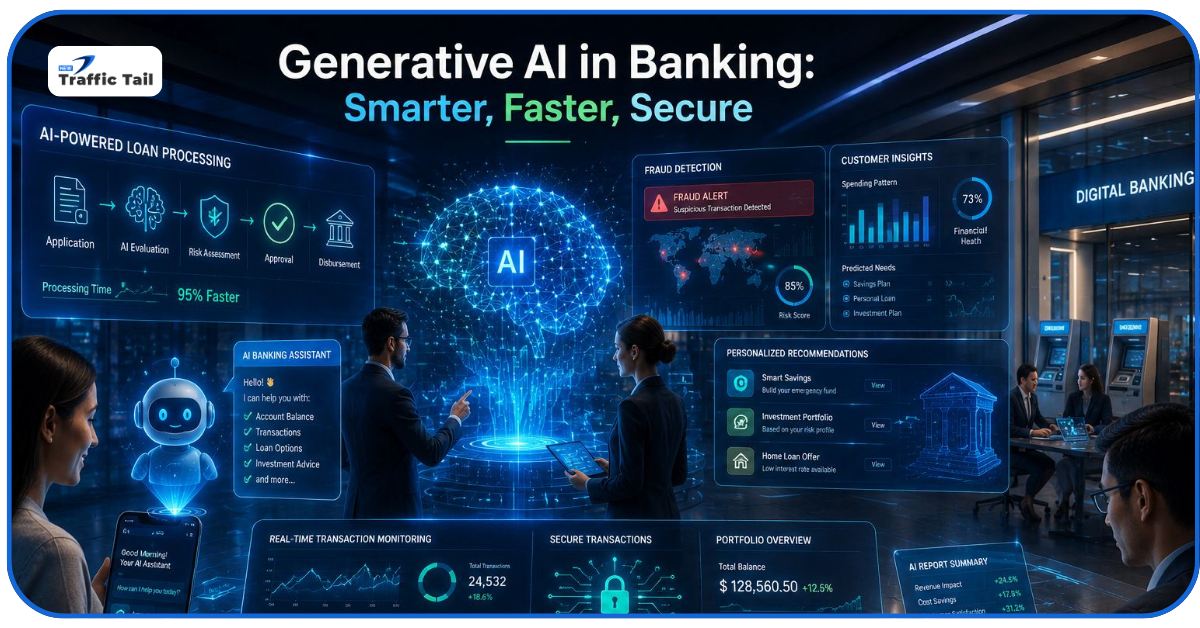
Traditional banking has always carried high operational costs. Compliance documentation, customer onboarding, fraud reviews, and financial reporting — these processes are repetitive, time-consuming, and expensive to staff. Generative AI in finance cuts through that.
According to McKinsey’s research on AI in banking, the technology could add up to $340 billion in value yearly to the global banking sector, primarily through productivity gains. Early adopters are already seeing it. Banks using AI for document processing have cut turnaround times by 60–70%. Compliance teams using automated report generation are
freeing up analyst hours for higher-value work. The ROI isn’t theoretical anymore.
Core Advantages of Generative AI in Banking
● Personalization at scale: AI-powered banking solutions can analyze a customer’s transaction history, spending patterns, and financial goals to generate advice that would previously require a private banker. This used to be a service reserved for high-net-worth clients. Now it’s available to anyone.
● Operational efficiency: Back-office tasks can be automated without sacrificing accuracy. That means lower costs and faster turnaround for customers.
● Scalability: Traditional software needs to be rebuilt when business needs change. AI models can be fine-tuned and redeployed far faster. For banks entering new markets or launching new products, that matters enormously.
Key Use Cases in Financial Services
● Fraud detection and risk assessment: In fraud detection and risk assessment, the gen AI models can assess the transactions across millions of accounts, flagging anomalies that rule-based systems would miss. When combined with real-time decisioning, this reduces fraud losses.
● Personalized financial advice and chatbots: AI in financial services now powers conversational tools that go beyond scripted question responses. They can understand context, pull account data, and give genuinely useful guidance, not just
redirect users to a help page.
● Automated report generation and compliance documentation: Regulatory reporting is one of the most resource-heavy functions in any bank. Generative AI can draft Suspicious Activity Reports, Basel III disclosures, and internal audit
documents based on structured data inputs — cutting hours down to minutes.
● Synthetic data for training and testing: Banks cannot use real customer data for testing new systems. Generative AI creates synthetic datasets that mirror real- world distributions without exposing sensitive information — a major win for both
innovation speed and data governance.
● Content creation for marketing and customer communications: From product descriptions to personalized email campaigns, AI generates compliant, on-brand content at scale. Banks working with AI development services partners are building these pipelines into their marketing workflows.
Risks That Actually Matter
Generative AI is powerful
It is also imperfect. Here’s where banks need to be careful. Data privacy and security. These models need data to be useful — and in banking, that data is sensitive. Any deployment must include end-to-end encryption, strict access controls, and clear data residency policies. Feeding customer data into third-party AI systems without proper data processing agreements is not just a reputational risk — it’s a regulatory one.
Bias and hallucinations
Generative AI models can produce confident-sounding outputs that are factually wrong. In a credit decision or compliance document, that’s unacceptable. Human review checkpoints are not optional — they’re a requirement.
Regulatory compliance and model governance
Banks operate under some of the strictest regulatory frameworks in the world. The EU AI Act now classifies certain AI uses in financial services as high-risk, requiring conformity assessments and ongoing monitoring. In the US, the FDIC and OCC have both signaled that AI model risk management needs to meet the same standards as traditional model risk.
Vendor lock-in
Moving fast with one AI vendor feels efficient — until the vendor changes pricing, discontinues a product, or gets acquired. Banks working with AI consulting services partners should build with portability in mind from day one.
How to Reduce the Risk
The banks getting this right are following a few consistent principles:
● Start with low-risk use cases: Internal document summarisation, code generation for IT teams, and internal Q&A systems carry far less regulatory exposure than customer-facing applications. Build confidence there first.
● Establish governance before you scale: Bias audits, model risk management frameworks, and explainability requirements should be defined before deployment, not after something goes wrong.
● Keep humans in the loop: Especially for compliance outputs, credit decisions, and customer communications. Where AI assists, and humans decide.
● Treat AI vendors like any other critical third party: Due diligence, exit clauses, and data portability requirements belong in every contract.
What’s Happening Right Now (2025–2026)
The pace of development is not slowing down. A few things worth noting:
1. Agentic AI is entering banking
Rather than responding to a single prompt, AI agents can execute multi-step workflows autonomously — researching a client’s portfolio, drafting a rebalancing proposal, and generating the compliance paperwork, all without human intervention at each step. Early deployments are live at several tier-one banks.
2. Multimodal models are broadening what’s possible
The newest models can process text, data, images, and audio simultaneously. In banking, this means AI can review a scanned mortgage application, extract structured data, cross-reference it against policy rules, and flag exceptions — in one pass.
3. Regulation is catching up
The EU AI Act came into force in 2024 and is now actively forming how European banks approach AI procurement and deployment. The UK’s Financial Conduct Authority has published guidance on AI explainability in financial services. Banks working with fintech software development partners need to make sure their systems can demonstrate decision-making traceability.
Where This Goes Next (2027–2030)
Here’s where things get genuinely interesting. The near-term trajectory points toward three shifts:
● Hyper-personalized finance: We’re moving toward a world where every customer interaction — every product offer, every piece of financial guidance — is generated in real time based on that individual’s data. Not segment-level personalization, Individual-level.
● Autonomous finance: AI agents will execute routine financial tasks on behalf of customers and institutions — bill payments, rebalancing, tax optimization — within defined parameters and with human override capability.
● Quantum-accelerated AI: Still early, but quantum computing will eventually expand what AI models can process, particularly in risk modeling and portfolio optimization. Banks that are building AI-ready infrastructure now will be better
positioned to absorb this when it arrives.
Read More:
How Generative AI is Transforming Custom Software Development
The Bottom Line
Generative AI in banking is not a future story. It’s happening now, and the gap between early movers and late adopters is already widening. The technology has real limitations, but these are manageable with the right approach. What’s not manageable is waiting so long that catching up becomes the challenge itself. The banks that will lead in the next decade are the ones building the capability today, carefully but decisively.