
You call a company’s support line, expecting the usual hold music.
Instead, someone answers on the first ring. You explain your problem; they pull up your order, reset your password, and wish you a good day. This all takes less than 3 minutes.
Only after hanging up, you realise — you were talking to an AI voice calling agent.
Facing this scenario is hardly surprising these days, as more and more global brands (such as Amazon and The Home Depot) have entered the AI calling business.
India has always been a customer-support superpower. Its contact centres still handle billions of customer service tickets every year. But, on average, these contact centres lose up to 100% of their workforce every year.
Recently, there has also been a rapid rise in AI calling business in India.
Replacing a big chunk of that workforce with AI makes financial sense. But that’s not the only reason why this technology is taking off in India – faster than most Western countries.
We’ll explain all of those reasons in detail here.
What is an AI Calling Business?
AI calling is the use of speech recognition, large language models (LLMs), and text-to-speech synthesis to run live phone conversations — without the involvement of any human agents.
Unlike old-school, ‘automated’ call technology (‘press 1 for sales, 2 for support’), these new AI voice calling agents don’t play recordings or follow pre-written scripts.
They listen to whatever you actually say, work out what you mean, and quickly respond accordingly. They can even handle errors or misinterpretations the same way a human would.
A business ecosystem built around this technology is called an AI calling business.
These businesses aim to autonomously manage and resolve millions, if not billions, of customer service requests over telephone networks. For example, Mahindra Finance recently deployed AI call bots to serve its borrower base across rural India via a partnership with Sarvam AI.
Decoding the Rise of AI Calling Business in India
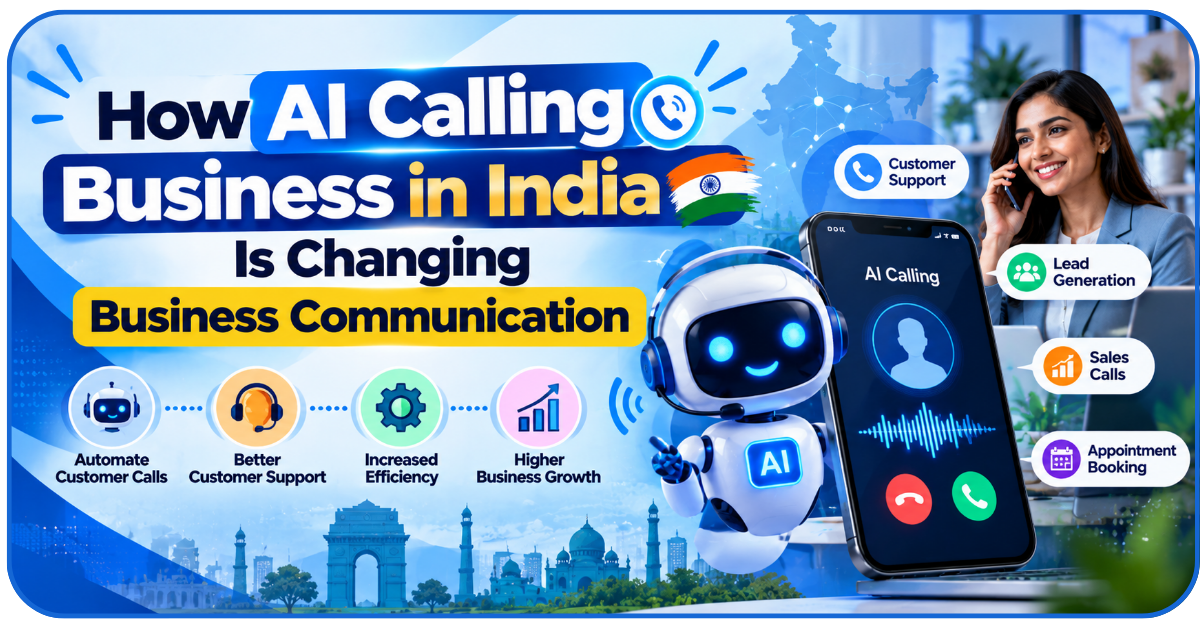
Mahindra Finance is just one of many examples of Indian businesses deploying AI calling technology. This trend is taking off for many reasons:
Enormous and Impatient Market
India has 1.4+ billion people and is home to one of the world’s fastest-growing digital consumer bases.
The average Indian today loses nearly 11 hours/year trying to resolve service-related issues. The productivity cost of such inefficient customer service is $ 55 billion per year.
A single festive-season sale can result in a small brand having to deal with 50,000+ calls in >48 hours. No workforce can scale elastically enough to absorb that demand – unless it uses automation.
Voice-First Customer Base
Globally, 76% of consumers still prefer phone support, and in India that preference is much stronger.
Indian consumers default to calling rather than emailing or self-serving through a portal — far more than American or European customers do.
When UPI payments fail, or deliveries stall, most Indians want verbal reassurance. All of this plays to AI calling’s strengths — instant response, in the customer’s language.
Linguistic Diversity
People have the misconception that AI calling business in India would never be successful because the country has 22 official languages and hundreds of dialects.
But human service agents are way more likely to fail in this context.
Recruiting Tamil speakers for the Chennai shift, Marathi speakers for Pune, and so on — all while fighting high attrition rates has been a logistical nightmare for human-led support centres.
Meanwhile, voice AI models can be trained in dozens of languages:
- Sarvam AI’s voice agents are trained to respond to ‘Hinglish’ and other code-switched speech
- CoRover’s BharatGPT provides voice support in 14+ Indian languages and is now being used by HDFC Bank
An AI calling business serving this much linguistic diversity will get way more ROI than a monolingual market ever could — because AI instantly eliminates geographic and linguistic recruiting boundaries.
Cost and Scalability
A human-handled contact-center call costs roughly $7-$12.
Voice AI handles the same call for about $0.40.
In the Indian context, that’s ₹4-6 per minute for AI vs. ₹25-30 for a human agent — a 75-85% cost reduction, with 0 recruitment or attrition costs on top.
The cost of AI is finally low enough to justify the human-to-voice AI switch.
Sector-Specific Adoption
Mahindra Finance’s successful adoption of voice AI has kick-started a cost-cutting ‘arms race’ in the fintech space. Now, other Indian banks (like HDFC) and NBFCs are rushing to adopt this technology.
This race is also kicking off in other sectors:
📚 EdTech firms want to use AI to dial thousands of student leads in admission season, answer fee/curriculum-related queries, and route serious candidates to human counsellors
🏠 Real estate firms plan to use AI bots to contact leads, verify budget and timeline in buyers’ preferred language, and book site visits directly into sales calendars
Not adopting this technology will now cost all types of Indian businesses more.
How an AI Voice Calling Agent Works
From the caller’s side, the experience of talking with an AI call bot is simple: you talk, it understands, and things get done in seconds. There’s a complex, 7-step system that enables this simplicity:
-
Customer Data Flows In
As soon as you call, the AI voice calling agent syncs with the CRM to pull up your purchase history, open tickets, loan details, etc.
By the time the call connects, the AI already knows who is calling and their probable needs.
-
AI Initiates/Receives the Call
For outbound calls (like sharing payment reminders), the AI uses cloud telephony networks.
For inbound support, the telecom infrastructure auto-routes calls to the AI server, which picks up on the first ring.
-
Speech Recognition
An automatic speech recognition (ASR) engine converts your voice into text in real time — while you’re talking. Indian ASR systems are trained on Indian accents and are designed to cut out background noise.
-
Intent Detection
A language model instantly analyzes the transcript from the ASR. The intent behind a query like ‘I want to pay back my loan’ will be – loan payback for Customer A, with other account details.
-
Response Generation
The LLM instantly references the company’s knowledge base, approved scripts, and business logic to draft a human-like response. It decides what to say next to advance the conversation.
-
Text-To-Speech (TTS) Delivers Response
Voice-Activity-Detection knows exactly when you — the customer — have stopped talking. Then, a TTS engine will convert the generated text back into lifelike audio.
This’ll keep happening until the AI voice calling agent resolves your issue. If you interrupt mid-sentence, the TTS audio buffer will flush in> 60 milliseconds, and the AI will stop talking to listen.
-
Interaction is Recorded, Analysed
Once the call ends, the AI will log into the CRM the:
- Call summary
- Outcome
- Full call transcript
It’ll then analyze the call’s pros/cons and use that data to improve future performance.
IVR vs AI Voice Calling
Compare this to how traditional Interactive Voice Response systems (that ask customers to press buttons to hear recorded messages) operate:
- Users don’t land in the wrong queue when they press the wrong button, so average handle time drops significantly
- Voice AI understands context, identifies high-value calls instantly, and routes them to humans (with summaries) – instead of blind-transferring impatient customers between departments
- The AI reviews 100% of its own conversations, learns which phrasing produces better outcomes, and auto-improves constantly – unlike IVR systems that only improve with manual reviews
How AI Calling Supports Digital Marketing
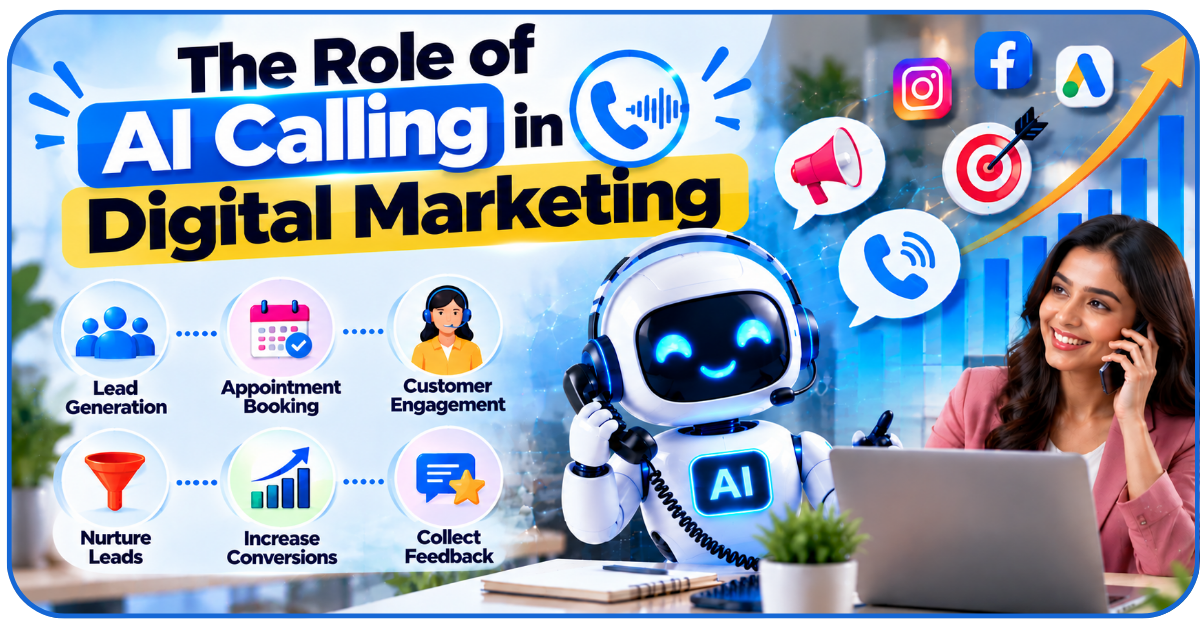
Digital marketing has digitized, automated, and optimized almost everything, from ad bidding to email marketing, except the one step where money actually changes hands – responding to leads.
Over 60% of B2B SaaS companies routinely fail to respond to and qualify the leads their digital marketing efforts generate.
The funnel: Digital Marketing → Leads → Qualification → Human Sales Team → Conversion – leaks right when marketing hands off leads to humans.
Here’s how AI call bots can fix this leak:
- Lead Generation: As soon as Google Ads or a landing page captures a lead, an AI business calling app (that’s integrated with the CRM) can make a personalized call seconds after the form is submitted – while the customer’s intent is at its peak
- Lead Qualification: The AI can ask BANT-style questions (budget, authority, need, timeline) on every single call, without bias, and auto-answer all follow-up questions – until the lead is fully primed; it can then auto-send all qualified conversations to human closers
- Lead Nurturing: What if a customer drags a purchase for months? The AI voice calling agent can schedule routine check-in calls, reference past conversations, and keep the relationship warm without involving human agents
- Campaign Follow-Ups: Bots can call thousands of users who download eBooks or sign up for webinars, gather feedback, and pivot the conversation to the next step in the funnel
- Appointment Conversion: They can call every lead hours before a demo purchase or site visit, confirm their interest, gracefully handle rescheduling, and auto-update the business calendar
- Customer Feedback: The AI call bots can perform post-purchase voice surveys and probe deeper whenever customers sound dissatisfied
Investing in an AI calling business can help companies ensure that every dollar they spend on marketing has a higher conversion potential. It can transform a leaky funnel into this:
Digital campaigns→ Leads→ Consistent AI Calls → Qualification→ Human sales team→ Higher Conversions.
AI Calling Business in India: Use Cases
Just like with digital marketing, AI call bots can radically transform a variety of Indian sectors:
| Industry | Applications | What the AI Voice Calling Agent Can Do |
| Real Estate | Enquiry Handling
Lead Qualification |
Call leads within 60 seconds in their preferred language + dialect
Book site visits into the sales calendar Confirm client visits 24 hours prior |
| Education | Admissions
Course Enquiries |
Handle thousands of simultaneous queries during busy result season
Explain fees and curricula Reactivate dormant leads from past admission cycles |
| Healthcare | Appointment Reminders
Follow-Ups |
Call patients in Tamil/Marathi 24 hours before OPD visits
Reschedule no-shows Check post-discharge recovery/medication adherence |
| Banking, Finance | Reminders
Collections Cross-selling |
Send early-stage EMI reminders in the borrower’s regional language
Make personalized FD and mutual-fund offers |
| E-commerce | Order
Communication |
Confirm cash-on-delivery orders to cut return-to-origin losses
Resolve thousands of ‘Where’s my order?’ queries during busy, festive periods |
| Travel | Bookings
Confirmations |
Confirm late check-in
Alert guests to schedule changes with personalized messages |
| Insurance | Renewals
Claim status |
Call policyholders weeks before lapse
Explain grace periods in regional dialects |
| D2C | Sales Follow-Ups
Feedback |
Recover abandoned carts with dynamic discount offers
Collect post-delivery feedback on product quality |
India’s multilingual environment makes the use of voice AI more necessary in every sector.
Let’s say a property buyer in Ahmedabad wants guidance exclusively in Gujarati, or a patient in Chennai needs immediate health guidance in Tamil.
Human agents struggle in such scenarios. But AI voice calling agents can instantly detect callers’ linguistic needs and auto-switch to dialects they’re most comfortable in.
AI Business Calling App vs Traditional Calling
Here’s how AI voice calling agents compare to human callers in other metrics:
| Traditional Calling | AI Calling | Impact on Customer Service |
| Human agent for every call | All routine calls are instantly automated | AI business calling apps can fully handle calls that involve repetitive tasks (like checking customer status) – and allow human agents to focus on calls that require human judgement |
| Limited by workforce | Can effortlessly handle high volumes | Businesses can run thousands of concurrent calls during peak events
Call centres don’t need hiring sprees during festive seasons |
| Manual follow-ups | Automated follow-ups | AI call bots never forget to make follow-up calls
Every lead in the CRM is nurtured and responded to in time |
| Manual call records | Automated data capture | Every call is auto-transcribed and synced to the CRM for outcomes and analysis
Call quality improves automatically with time |
| Scaling requires hiring | Scaling means changing a setting | To scale their voice-support capabilities, firms only need to upgrade their API limits – not undertake 3-month-long recruitment/training cycles |
| Human-led conversations | AI-led conversations | Perfectly consistent messaging
Full regulatory adherence on every call Important calls are quickly routed to human agents |
While AI call bots certainly outperform human agents in many metrics – there’s still enough room for humans in the broader AI calling business ecosystem.
A significant % of calls still require human intervention, like when:
- Negotiating large contracts
- De-escalating irate customers
- Resolving multi-layered disputes
AI frees human agents from the soul-crushing repetitive tasks that historically drove the high attrition rates. They can deploy better empathy and problem-solving skills to manage the lower volumes of high-value calls. That’s why call center employment is still skyrocketing in India.
What Businesses Should Consider Before Using AI Calling
Now, before you look up ‘AI business calling app’ and sign up for the first platform that shows up – you need to evaluate if the service you’re signing up for is actually worth your money:
⏳Call Quality and Low-Latency: The AI call bot must have a sub-500-millisecond response time – if it pauses for 1 second, the illusion of the conversation feeling natural will shatter
🗣️Naturalness of Voice: Does it respond like a real human? Does it stop when you interrupt it?
🇮🇳Indian Language Support: Does the bot understand all the languages you aim to serve your customers in? Does it understand code-switching or mixed-speak like Hinglish? Generic US-centric platforms fail at these tasks, and you’ll likely need an Indian-made solution
👨🏻💻CRM Integration: Does the AI agent integrate seamlessly with your CRM – including updating it with the transcripts and outcomes of each call in real-time?
🔐Data Security: Does it encrypt all customer data when it’s at rest, in transit, or in storage? If you’re operating in a regulated sector – make sure the tool is approved for use there
🤝Customer Consent: The AI should automatically ask for customers’ consent when recording them and time-stamp that action — for every call
🔴Call Recording: Full recording and transcription should be standard offers (not premium add-ons), for QA and compliance
🫱Human Handoff: The AU must auto-route the call to human agents whenever it detects frustration or hears trigger terms like, ‘I need to speak with the manager’
🎯Response Accuracy: Verify if the AI only learns from approved knowledge bases, and if it can transfer calls to humans whenever it doesn’t have enough info — rather than inventing false answers
⚖️Regulatory and Telecom Compliance: The tool must be compliant with the latest TRAI, DLT, and DND standards
📈Cost vs. Expected Value: Calculate how much money the tool can actually save for your business vs. hiring human callers – instead of taking what these AI voice firms advertise at face value
You also need to clarify which calls you plan to automate and which ones you want your human agents to take. Create this plan before paying for any tool. Also, make sure the tool has an easy-to-use interface that makes it easy to set up controls regarding human handoffs.
The Future of AI Calling Business in India
All current trends point to the same conclusion – India will become the most important market for automating voice call support.
Today’s AI call bots already handle all the major Indian languages. The next-generation bots will become masters at offering support in hyper-local dialects.
Not only will their ability to understand callers’ emotions improve drastically – they’ll even get better at predicting the outcome of each call and flagging at-risk accounts to managers before they churn.
They’ll also get better at customizing every response to the individual user’s needs, and they’ll even be able to send WhatsApp messages, emails, and calendar invites mid-conversation:
‘Let me email you that confirmation code right now!’
Every major gap between marketing (generating leads) and sales (converting leads) will dissolve, and each of these developments will compound the others.
So yeah, the AI calling business in India is only getting started!
Conclusion
AI voice calling agents will transform the world of business communications forever.
The businesses that’ll ‘win’ this transformation are the ones that treat this technology as a tool to primarily improve customer service – not to cut costs.
The AI calling business ecosystem still desperately needs high-quality human operators.
So, instead of mass-firing their human agents, businesses must focus on improving their lives by giving them the right tools.
That’s the only way this transformation can be a good thing for a business.
FAQs
Q1- Can small businesses afford AI calling technology?
Yes. Costs now can be as low as ₹2-8 per-minute with low upfront platform fees.
Q2- Can AI calling systems work with Indian regional languages?
Yes, but test how good the system is with specific languages before you scale.
Q3- What happens when an AI calling system can’t answer a question?
A well-built system will instantly transfer the call to a human agent with the call’s summary.
Q4- Can AI calling be integrated with CRM software?
It absolutely has to! Avoid any tool that doesn’t integrate!
Q5- Can AI make decisions during a business phone conversation?
Only if the decision falls within the business rules, permissions, and workflows you define for it in advance (like authorizing discounts).