
Starting a solar business in India is no longer as simple as buying Chinese solar panels in bulk and selling them to local customers. Over the past few years, the Indian government has launched several plans to reduce dependence on China. Local firms that’ll thrive in this new phase of Indian solar power expansion will be those that do the same and focus on local solutions.
They must focus on providing localized services like arranging locally-sourced equipment, coordinating installations in lesser-served areas, and facilitating state-level electricity-board approvals. In this blog, we’ll explain how to start a solar business in India in the current government, corporate, and social environment – in 7 simple steps.
Here’s what these steps will focus on.
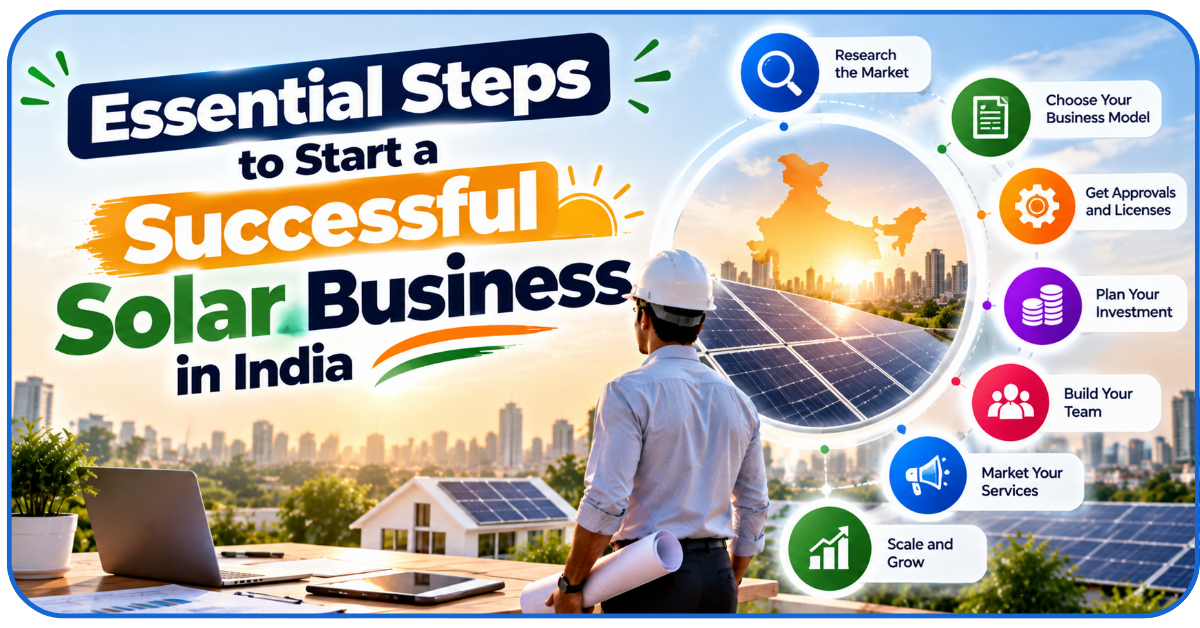
How to Start a Solar Business in India: 7 Successful Steps
Currently, over 51 lakh Indian households have rooftop solar installations. These homes have benefited from the PM Surya Ghar program that aims to bring that figure up to 1 crore over the next 3 years. In the long run – that figure could be well up to 10 crore or more.
So, there’s plenty of room for ambition and growth. But the 51-lakh figure also tells us that the Indian solar power market is no longer an ‘emerging’ market.
It’s now a fully functional market where newer entrants can focus on targeting specific locations, services, business models, and niches. We’ll explain how you can select the right niche, model, location, and service in these 7 steps – and then build on from that starting point
-
Understand the Solar Industry and the Market
Start by identifying:
- Who needs your services
- What they currently spend on electricity
- What prevents them from adopting solar power
There are 4 main ‘who’s’ to target:
- Residential rooftop installations
- Commercial and industrial systems
- Agricultural applications
- Maintenance services for existing installations
These 4 solar power sectors have different customers, technical requirements, and payment cycles:
- Residential rooftops can be a sensible starting point for technical entrepreneurs who want to serve specific local areas
- Commercial projects are larger but need businesses with stronger financials, technical expertise, and longer-term service commitments
- Agricultural and utility-scale projects have their own complications regarding land, grid connectivity, offtake, and financing
Once you pick one of these lanes, you need to select a market that’s the right amount of underserved and technically potent. Here’s the current state of the solar business in India:
- Gujarat has 6000+ MW of rooftop solar capacity already
- Maharashtra has 5000+ MW
- Rajasthan and Kerala have also drastically expanded their rooftop markets in recent years
Eastern and north-eastern states are currently lagging, so they may be viable targets for new businesses. But a less-developed market isn’t automatically easier to enter.
Adoption there may be held back by:
- Limited solar panel installer networks
- Weaker consumer awareness
- Financing barriers
- Difficult local approval processes
Before you select what service you want to provide, and where you want to operate, speak with:
- Target customers in those locations to learn what their needs are. Is it reducing bills? Improving energy reliability? Assistance with installations and maintenance?
- Solar owners in your target location to see how long feasibility approvals, net-meter procurement, and export-credit adjustments actually take on the ground.
Do other forms of research as well:
- Read local Google reviews of existing vendors to spot recurring complaints or service gaps
- Learn what local electricity tariffs solar power businesses can earn there
- Who are the main competitors in that service area and location, and what is their financial outlay
- What business/compliance procedures are required by your target location’s distribution company (DISCOM)
Then, anchor your launch around a specific segment. For example – small homes with monthly bills above ₹3000 in a specific agricultural region.
-
Choose a Business Model That Fits Your Skills and Capital
Have you decided which market and customer type your solar firm should target? Next, you’ll have to decide what business model is best to serve them. Your options include:
| Solar Business Model | How it Generates Revenue | Main Considerations |
| Dealership or Distribution | Selling solar panels, inverters, and related equipment | Securing inventory
Securing supplier credit Payment collections |
| Installation or EPC* | Designing and executing solar projects | Technical capability
Project delivery Working capital |
| Consulting or Sales | Charging fees or earning disclosed commissions | Credible partners
Clearly-defined responsibilities |
| Maintenance and Repair | Service visits and maintenance contracts | Skilled solar power technicians
Travel costs Recurring demand |
*EPC stands for engineering, procurement, and construction
Here’s how newcomers should approach these solar business models
- Owning a solar plant and earning revenue from the electricity it generates is a capital-intensive investment business – suitable only for solar startups with considerable financial backing
- EPC contractors design the installation, source equipment, coordinate the work, test the system, and hand it over to owners – this is a low-investment option for technical teams
- For total newcomers without highly technical teams, generating qualified leads for an established installer or offering clearly scoped consultancy are also good options
- Teams with just electrical experience are better positioned for maintenance and installation services
To learn which of these models suits you and how to start a solar business in India, study:
- Supplier access in the area you’re targeting
- Local demand
- Inventory economics required to support your business goals
The right model is not the one with the most revenue potential. It’s the one you can execute reliably.
-
Estimate Investment and Startup Costs
A solar EPC startup in India may require approx. ₹5-₹20 lakh in initial procurement funding for:
- Solar panels
- Inverters
- Mounting structures
- Testing devices
- Registration fees
They’ll also have to account for recurring costs like:
- Recurring overheads (staff, transport, marketing)
- Project working capital (freight, installation labour, testing, commissioning and expenses)
- Service and contingency reserves
They’ll have to arrange capital for all of these costs long before they secure their first customer. That’s why they must never overlook the time between paying suppliers and receiving the customer’s final payment while budgeting. Here’s why this is important:
- Let’s say you land a rooftop project worth ₹2 lakh
- Total costs for the project are ₹1.5 lakh
- The customer just pays ₹60,000 in advance
- You face a temporary cash gap of ₹90,000
- You have to borrow the rest
Here, borrowing will only work when you take enough measures to ensure your payment and repayment schedules are in line. Now, multiply that gap across several simultaneous projects.
See what kinds of financial pressure a solar business in India has to typically deal with?
To pre-emptively address these types of pressures:
- Prepare month-by-month cash-flow forecasts before accepting orders
- Set up strict supplier payment terms
- Have a contingency reserve (back-up cash) for every project
-
Register the Business and Verify Project-Specific Compliance
There is no single ‘solar licence’; government agencies will guide you when you ask them, ‘how to start a solar business in India?’ Compliance arrives in three layers, and your model will determine which ones apply to your business
Layer 1. Business and Tax Setup
Choose a structure — proprietorship, partnership, LLP, or company. Then:
- Obtain PAN
- Open a current account
- Complete GST registration
You can opt for Udyam registration to get MSME status and its lending and protection benefits.
Layer 2. Electrical and Project Approvals
Most states require electrical work to be executed/supervised under an electrical contractor licence. Learn about this by speaking with local authorities and local solar power experts.
Layer 3. Scheme, Vendor, and Equipment Eligibility
If you want PM Surya Ghar work, you must register as a solar business vendor on the national portal.
Learn about the vendor registration process, pay the necessary fees, and make sure you meet the collateral the local bank you’re working with demands.
-
Find Reliable Suppliers and Build a Delivery-Ready Team
By now, you have a clear idea of the market you’re working in, the people you’re serving, and the types of projects you’ll be undertaking. The equipment you procure from this point must:
- Suit these conditions and the types of projects you plan to undertake
- Meet applicable requirements
- Come with documentation and warranty support that the business can actually use
Thanks to India’s growing solar panel manufacturing base, you’ll have many supplier options who sell equipment that meets these criteria. Compare these suppliers on the basis of their:
- Traceability
- Availability
- Delivery time
- Payment terms
- Warranty claims (typically 10-12 years)
- Replacement support
- Technical assistance
- Their ability to deliver the specific types of solar panel modules and inverter specifications you’ll need for your projects
Also, make sure your team is trained to work with the tools the suppliers provide. This team will have to consist of:
- Well-trained solar panel and equipment installers
- Appropriately qualified electrical personnel
- Roof access and structural assessment technicians
- Project managers responsible for documentation, certification, administrative work, etc.
The Suryamitra programme is a good place to look into for assistance on how to train solar power technicians.
-
Build a Marketing System That Produces Qualified Leads
You’ll need a strong marketing wing to bring in customers who are most likely to benefit from your service. For a residential solar business, local search is the most useful starting point.
A homeowner searching for ‘solar panel installation in Kolkata’ or ‘PM Surya Ghar vendor in Nagpur’ is more likely to have a specific need. Build a strong website, and partner with an SEO team that ensures all high-intent searches like this lead to your site.
Learn how your solar business site can attain domain authority to earn high-intent traffic.
Post helpful content on how homeowners can manage their solar power equipment and optimize that content with these keywords. Also, post content that makes your site appear as an authority on this technology, like in-depth guides and case studies on how to start a solar business in India.
- Create a complete Google Business Profile to make sure local searches can instantly learn about your business
- Maintain an informative website and publish dedicated service pages for the areas the business can realistically cover
- Useful content should answer questions about installation cost, potential savings, roof suitability, maintenance, warranty coverage, and the application process
- Post genuine project photographs and customer reviews on your site and social media pages
- Run location-specific search campaigns for relevant leads.
- Create dedicated landing pages with enquiry forms and clear calls-to-action
Make sure your site has a mechanism to qualify enquiries as well. A simple form should ask for the
- Customer’s location and DISCOM
- Recent electricity consumption
- Roof ownership or permission
- Daytime usage, budget, and decision timeline
Use a basic customer relationship management (CRM) system to record enquiries, follow-ups, surveys, quotations, and project metrics as well.
Don’t have an in-house team to take on so many responsibilities? A dedicated digital marketing partner can perform all of these essential business-building tasks on your behalf while you focus on the more technical aspects of your solar business.
-
Deliver Reliable Service
Every small and local solar business in India is relationship-driven. So, providing reliable and friendly service is the only way to build your brand. To do that:
- Make sure your project quotations specify what equipment you’ll install, the solar panel systems’ capacity, and the long-term scope of your work (including warranty terms)
- Never promise ‘0 bills forever’—explain that financial savings depend on solar irradiance, seasonal cloud cover, how much power the family consumes, and other technical details
- Walk the customer through the proposed module layout, cable routing, and inverter placement before drilling a single anchor bolt
- Assign written responsibility within your solar business team for seeing the project through DISCOM inspection, bidirectional meter installation, and other technical tasks
- Invest in brand and reputation management
- Guarantee that you’ll provide at least 5 years of comprehensive Operation and Maintenance (O&M) support
The best way to clarify all of these details is online on your website. And for your customers who don’t use the Internet – explain these nuances of solar power service to them in person.
Conclusion
Now that you know how to start a solar business in India, start planning!
Start with specific customer targets and set specific service-delivery goals.
Then, build a workable financial model around those goals and a delivery process that meets all local technical and regulatory requirements.
And since many buyers of solar technology tend to be digitally aware, make sure your solar business has a strong online presence from the start.
FAQs
Q1- Can someone start a solar business while working full-time?
They can do sales, consulting, or referral work. But EPC or distribution work requires site visits and installation oversight during business hours, so those avenues aren’t part-time-friendly.
Q2- How can AI help predict customer demand?
New solar businesses can cut costs by automating:
- Lead classification
- Following up with customers
- Energy demand forecasting
Q3- Can a solar business offer EV charging solutions?
EV charging has totally different electrical load profiles and regulatory requirements from rooftop solar. So scientifically, they can, but in reality they’re two separate fields that in India rarely overlap.
Q4- What is a PPA?
A Power Purchase Agreement is a contract to sell electricity at an agreed price over a defined term.
If you own solar power systems – you can sell PPAs. But that’s totally different to installing systems for project fees.
Q5- How can solar businesses earn carbon-credit revenue?
Potentially, but credits are not automatic for every installation. Eligibility depends on your sales and installation methods, business ownership model, and other business costs. Consult the Bureau of Energy Efficiency’s Indian Carbon Market framework to learn more.