
Remember how painfully tedious the buying process used to be for business leaders?
You’d have to dodge streams of irrelevant vendor calls, actively seek out the right suppliers yourself, and then brace for weeks of tiresome follow-ups.
Today, the experience is noticeably different.
Outreach is usually specific to the buyer’s situation, the timing of the outreach feels much more considered, and deals close considerably faster.
This change hasn’t come from sales teams suddenly working harder; it has come from smarter use of their time. It has come from the increasing use of highly specialized AI tools for sales teams.
According to McKinsey’s 2026 B2B Pulse survey, team leaders who’ve embedded AI tools into their sales workflows say that:
- Their sellers have become more efficient at their jobs (59% of respondents)
- The quality of experiences they deliver to customers has improved drastically (53%)
These improvements are naturally leading to more sales.
In this blog, we’ll profile the 10 best AI tools for sales teams enabling this kind of rapid growth. Each tool optimizes a key stage of the sales cycle and improves the sales team’s overall efficiency, their chances of closing sales, and the buyer experience.
What Are AI Tools for Sales Teams?
They are software platforms that fully automate, partially automate, or augment tasks across the sales cycle by using:
- Machine Learning (ML)
- Natural Language Processing (NLP)
- Predictive Analytics
Here’s how AI tools for sales teams work:
🔍 Finding Prospects: They scrape LinkedIn, company databases, and the open web to build lead prospect lists that would take humans weeks to compile.
🔏 Lead Qualification: They rank every potential lead based on their intent, behavioural signals, and firmographic fit — so that reps can then personally focus on the right, high-intent buyers.
🔬 Customer Research: They can read gigabytes’ worth of 10-K filings, job postings, LinkedIn activity, and other business data in seconds — and share highly detailed insights about target customers
📢 Personalized Outreach: Once these tools find the right leads, they can even draft emails or LinkedIn messages that contain information about their business needs, mutual connections, and other response-inducing, personalized details
🔁 Follow-Ups: They can also send personalized reminders, track how engaged each potential buyer is/isn’t, and alert reps whenever prospects open proposals, revisit their pricing discussions, or show any other sign of purchase intent
📈 Sales Forecasting: By analysing historical sales data, deal velocity, and other customer engagement signals, these tools can also predict how each sale will likely turn out and then give team leaders highly nuanced forecasts about individual/monthly sales prospects
⚙️ CRM Management: They can also transcribe calls and populate CRM fields automatically — which means reps can spend less time doing admin work and more time on personalizing their customer outreach efforts
💬 Conversation Analysis: AI tools can review recorded calls and chat logs of successful or unsuccessful deals, identify what top performers do differently, assess how/why certain sales went through or didn’t, and then give clear strategies on how to improve a team’s overall selling efficiency
How AI Tools Can Help Sales Teams
Automating these different functions helps sales teams in a multitude of different ways:
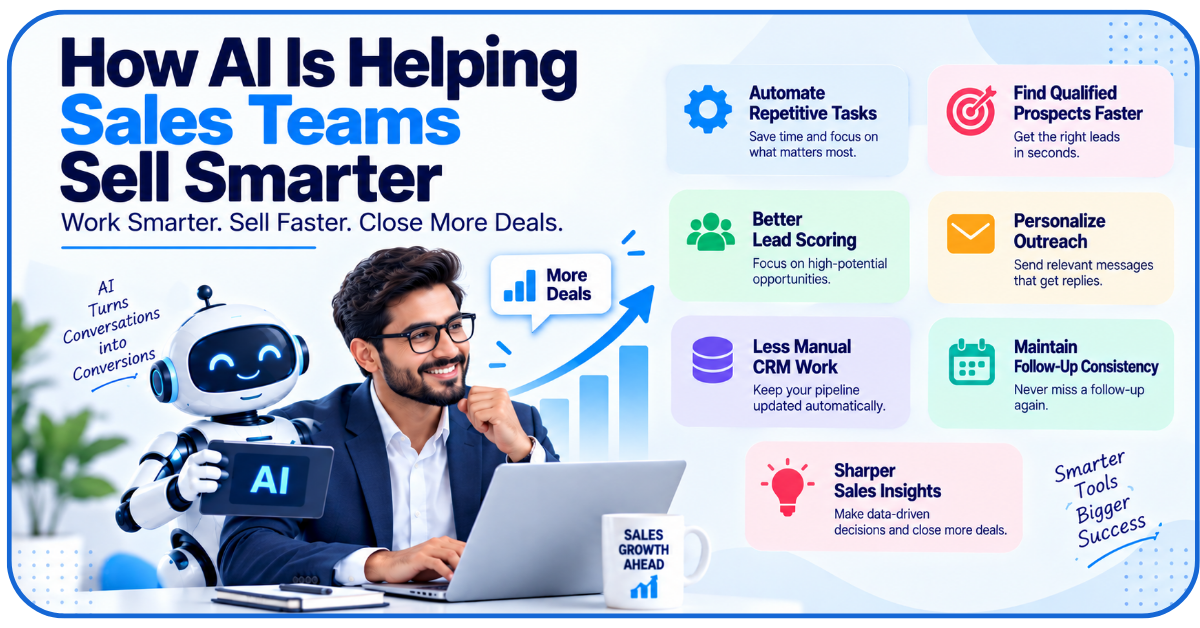
⚡ Automating Repetitive Sales Tasks: As AI handles tasks like list building, customer data gathering, email sequencing, and sending timely follow-up reminders, reps can focus on building trust with customers or resolving their issues personally
💨 Finding Qualified Prospects Faster: AI-powered sales software can consolidate data from LinkedIn, internal databases, and emails – reps can then query this data with a single search and find qualified prospects within seconds
⚖️ Better Lead Scoring: These tools can analyse a prospect’s historical conversion data and their behavioural data to score leads based on their propensity to buy — not just basic demographic fit
💌 Personalizing Outreach: Mentioning details like specific business issues in outreach messages can drastically boost the chances of receiving replies from potential buyers
🛠️ Less Manual CRM Work: Before AI, CRM updates were a tedious, after-work chore; now, conversation intelligence tools extract action items and push them to Salesforce or HubSpot automatically, and all pipeline data stays current
🗓️ Maintaining Follow-Up Consistency: While humans stop following up after 3-4 rounds, AI tools can make 9-12 strategically timed follow-ups to rescue deals at far higher rates
🧠 Sharper Sales Insights: AI tools can analyze terabytes of actual call data, deal histories, and email patterns to discover unique conversion trends, highly-specific improvement opportunities, and a host of other sales insights
The 10 Best AI Tools for Sales Teams
Now that you know what these tools can do, let’s find which ones perform these functions most effectively. Now, not every sales team struggles with deals at the same stage. So, we’ve selected 10 specialized tools that are the strongest options for the 10 different stages of the modern sales cycle:
1. Apollo.io
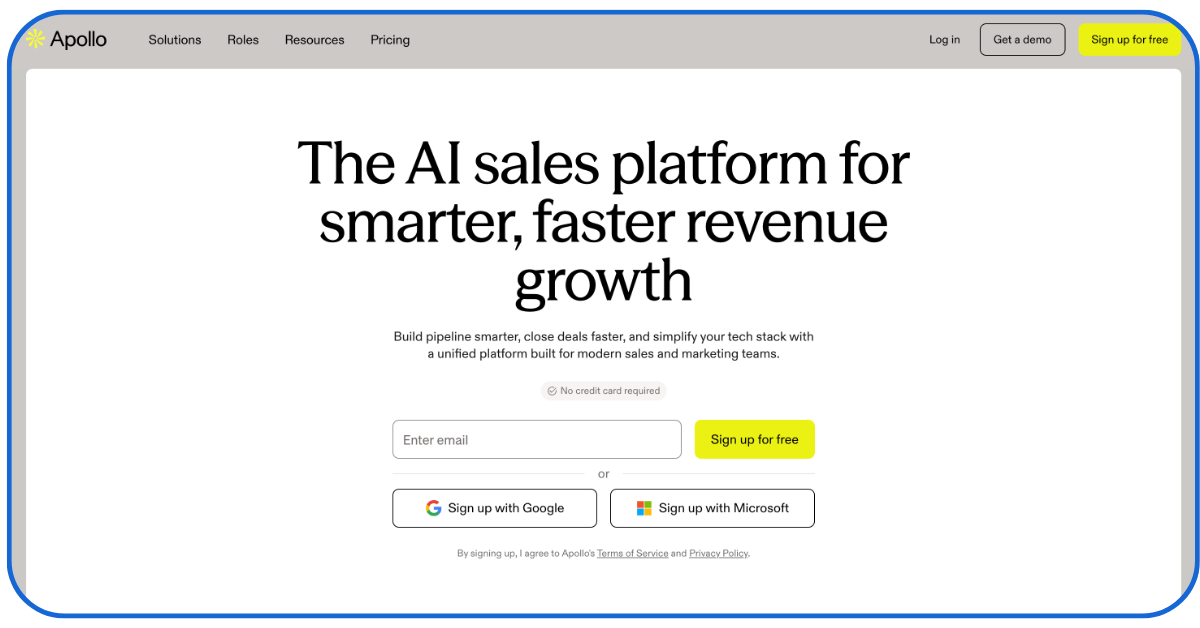
Every outbound sales initiative begins with one question — who should you actually be talking to?
Apollo.io answers this question by giving you access to its database of:
- 275+ million contacts
- 73 million companies
Reps only need to describe their ideal customer profile in plain English. Then, Apollo will:
- Build the list
- Enrich the list with verified emails and phone numbers
- Route leads directly into multi-step sequences or diallers
From its easy-to-use interface, you can also automate routine tasks like:
- List-building before each campaign
- Verifying every contact in the company database
- Sequencing outreach steps based on customer data
Without a tool like this, reps would have to spend half their time manually cross-referencing LinkedIn profiles, guessing email formats, and updating their CRM records. Apollo’s free tier with 10k+ email credits per month also makes it the most valuable entry point in this category.
2. Clay.com
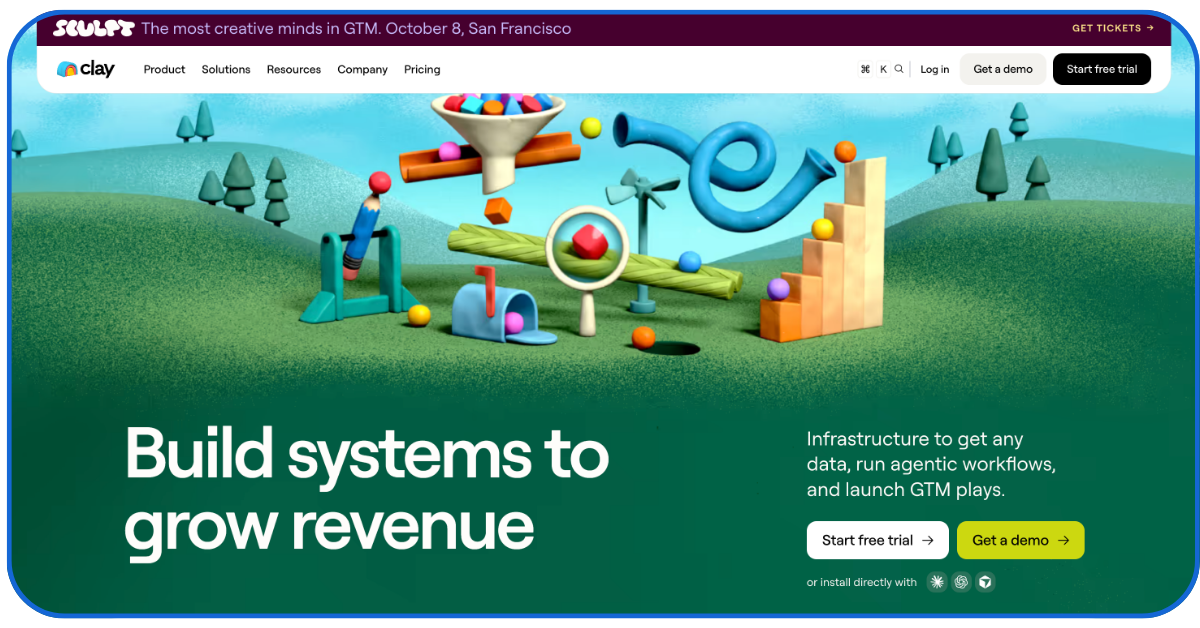
Raw contact data is worthless without context. Clay provides that context by running waterfall enrichment across 50+ data providers simultaneously. Feed it contact data and it will:
- Find out all relevant recent news about the target buyers
- Fetch data about their hiring patterns and tech stack changes
- Cross-reference their firmographics
- Track their funding history
- Analyze their real-time web data
In no time, it can
- Build multi-dimensional profiles of every potential buyer you want to target
- Offer clear explanations of how each data point was fetched on its easy-to-use spreadsheet-like interface
Clay is one of the best AI tools for sales lead generation and can save teams hundreds of manual research hours every week.
3. Conversica
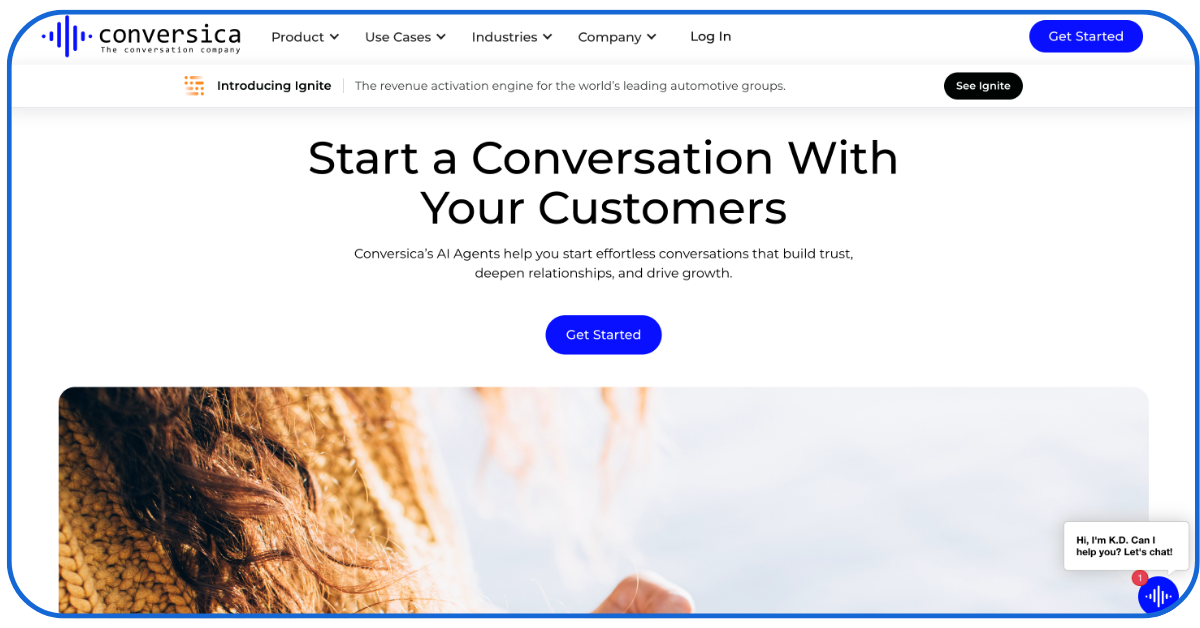
What happens when sales teams engage with leads 5 minutes after they submit queries? Conversion rate probability increases 21x.
With Conversica, sales teams can easily and consistently meet this engagement threshold. It deploys an AI virtual Sales Development Representative that engages ALL inbound leads immediately across:
- SMS
- Chat
After engaging each lead, Conversica’s generative AI interprets their intent and sentiment and conducts two-way dialogues by:
- Asking qualifying questions
- Handling their queries and objections
- Routing every sales-ready prospect to human reps
Conversica is also one of the most popular AI tools for sales lead generation. To set it up, teams will have to first map out their lead qualification criteria and train the AI on their brand voice. But once deployed, Conversica will operate invisibly in the background and help qualify countless leads that stay dormant in most CRM contacts.
4. Jasper
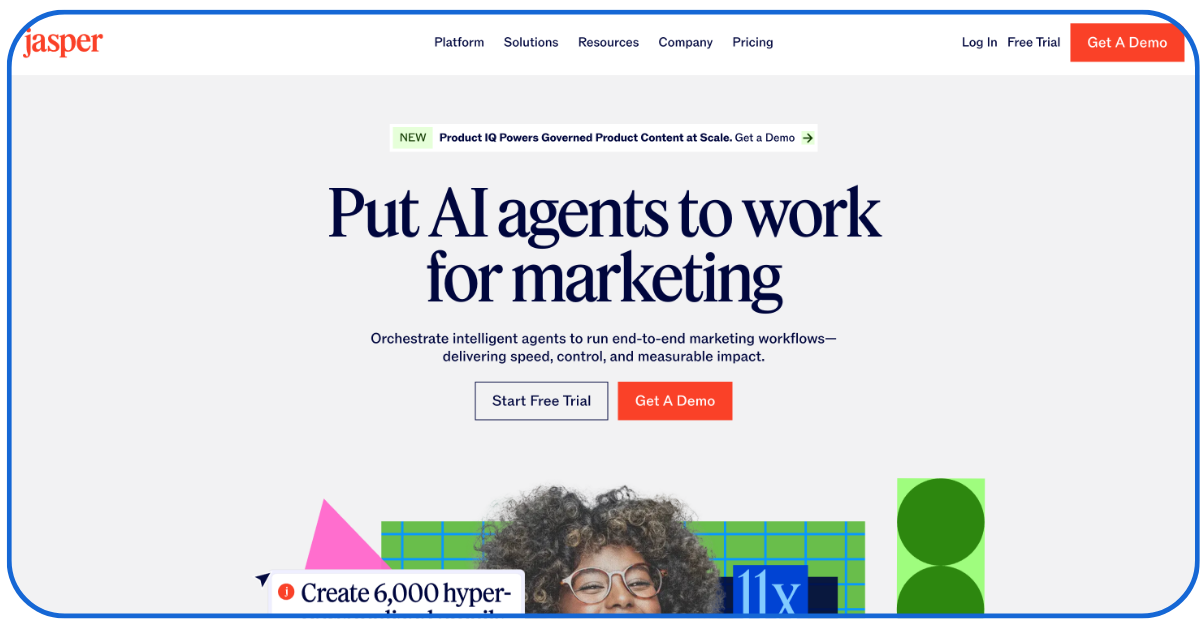
Top-quality sales content is often the only thing that separates a qualified lead from a closed deal. But it’s hard for teams to produce top-quality, customized pitch decks for large volumes of leads.
Jasper is one of the best AI tools for sales teams struggling with this stage of the sales cycle:
- The Jasper IQ contextual engine can be trained on brand voice guidelines and product knowledge
- It can then generate world-class sales content, outbound sequences, pitch decks, ad copy, and landing pages within minutes
- There are over 50 pre-configured templates for sales and marketing
Jasper can generate endless amounts of content for multi-channel sales campaigns — just from a single brief.
5. Lavender.ai
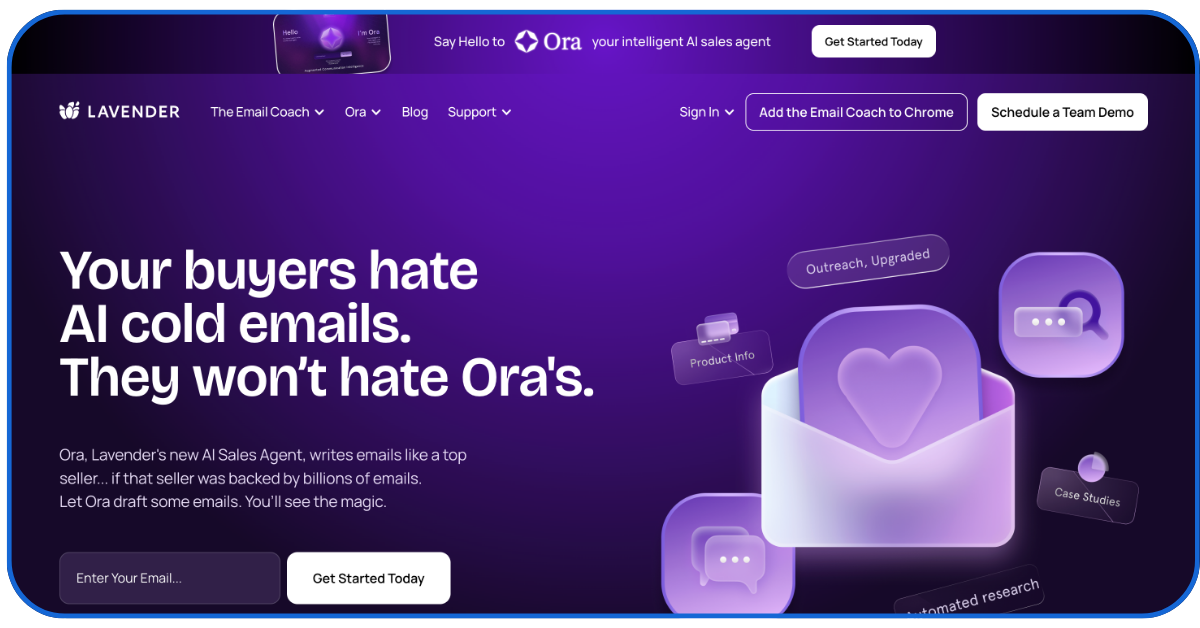
Most cold email campaigns fail for the same fixable reasons. They’re usually:
- Too long
- Written solely from the sender’s perspective
- Full of phrases that trigger spam filters
Lavender fixes all of these issues in a simple way:
- It can be easily added to the Chrome browser of every sales rep
- The tool scores every email they type (0-100) in real-time to ensure these issues aren’t present
- It flags what’s dragging the score down and suggests specific improvements
Lavender will optimize every email for potential buyers on the spot, and drastically improve their chances of securing replies. It’s a must-use for everyone in sales:
6. Gong
A lot of the finer details that determine whether a deal closes or not make it into the CRM, like:
- Was a competitor mentioned in passing?
- Was a budget concern raised and dropped by the rep?
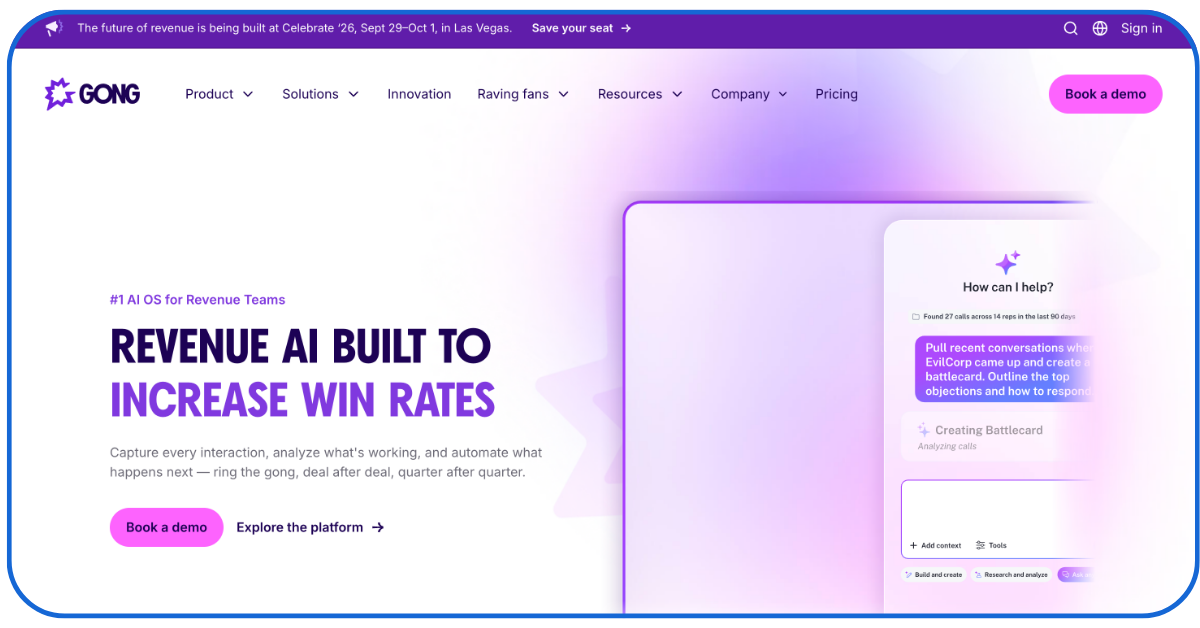
As one of the best AI tools for sales teams, Gong captures all of it. It records, transcribes, and semantically analyses every customer interaction across calls, video meetings, and emails.
Gong’s AI, trained on 3+ billion customer interactions, also identifies deal risks before they become deal losses and identifies the conversational behaviours that the top performers use to win.
7. Salesforce Sales Cloud (Agentforce + Einstein)
Past a certain team size (over 50 reps), using a standard, static CRM doesn’t work anymore. Data gets siloed, pipeline visibility breaks down, and more handoffs fail than succeed.
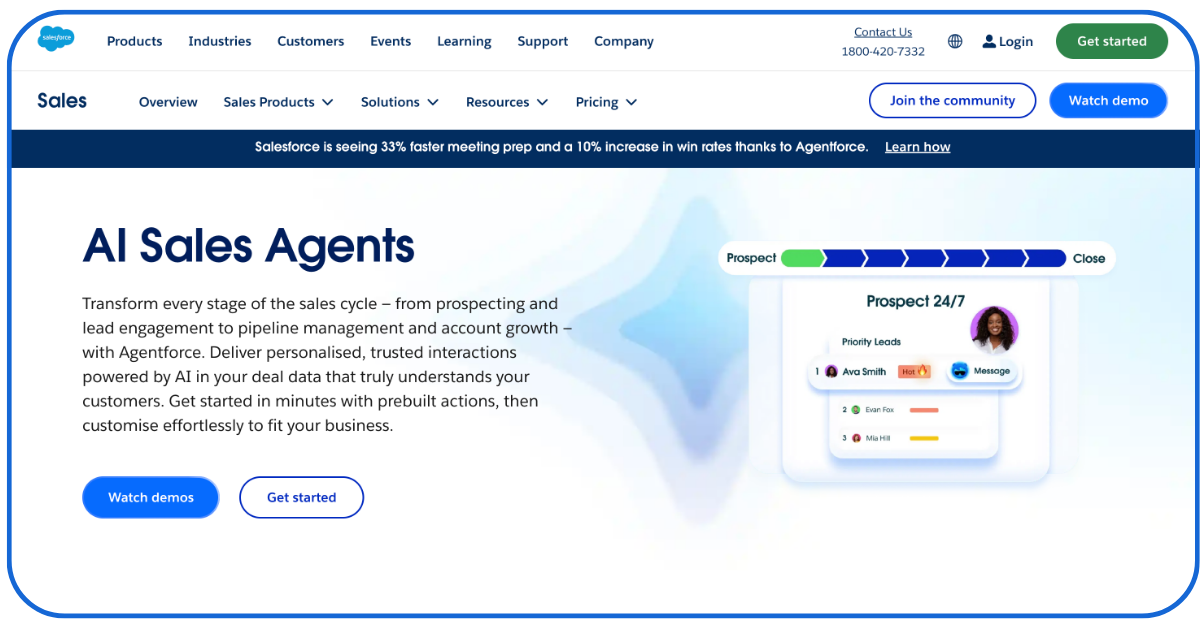
Salesforce Sales Cloud, with Einstein AI and Agentforce’s autonomous agents, transforms the old static CRMs from static databases into autonomous systems of action that can:
- Find sales opportunities on its own
- Predict outcomes of current deals
- Execute intelligent multi-step sales workflows without requiring human triggers
Here’s how this combo works:
- Einstein handles predictive lead scoring and deal insights
- Agentforce facilitates autonomous lead nurturing and CRM updates
8. Clari
The much-loathed end-of-the-quarter shock deals that were supposed to close, but didn’t, are almost always a forecasting failure.
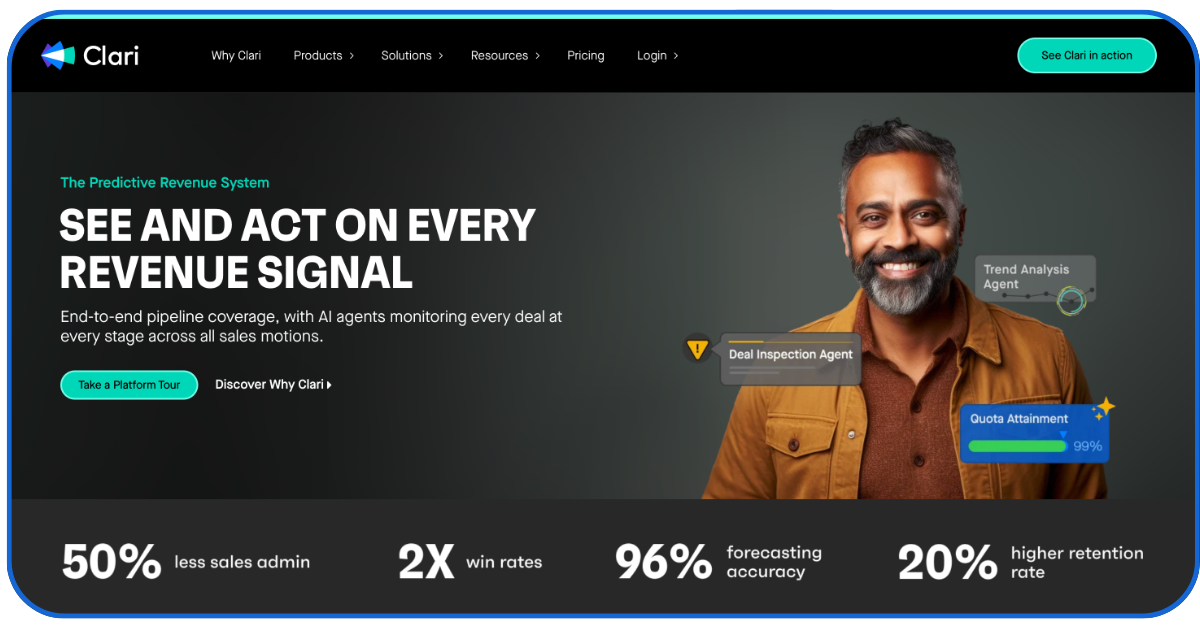
Traditional forecasting relies on what reps say about their deals and thus is heavily biased. Clari removes that subjectivity by running algorithmic forecasts on deals, based on:
- The email velocity between the seller/buyer
- Their meeting frequency
- The deal progression rate
- The reps’ historical win rates
- Other engagement signals
With 95% average accuracy and over $4 trillion in revenue forecasted across its ecosystem, Clari is one of the most essential AI tools for sales teams that routinely miss their earnings calls.
9. PandaDoc
Deals that are on the verge of closing often don’t, just because the proposal process experiences unnecessary friction at exactly the wrong moment, in the form of:
- Subtle manual formatting issues
- Pricing errors
- Unnecessary legal back-and-forth
- Multiple email chains forming around a PDF, confusing both parties
PandaDoc was created to eliminate this sort of friction:
- It auto-generates customized proposals from CRM data
- With one click, reps can get fully-populated, on-brand, ready-to-send contracts
- The tool tracks recipient engagement in real-time (shows when a prospect opened the proposal and how long they spent on pricing)
- It also collects legally binding e-signatures
Sellers who don’t use PandaDoc today make their brands look professional by sending error-ridden Word files or PDFs and stretching deals for weeks.
10. Gainsight CS
The sales funnel doesn’t end at signature. For recurring-revenue businesses, only long-term retention and constant expansion can drive long-term value.
Traditional post-sale management is reactive — account managers hear about problems after the customer is already frustrated. Gainsight CS makes this process reactive by:
- Constantly monitoring product telemetry, support ticket sentiment, and stakeholder engagement
- Synthesizing those signals into Health Scores that predict churn before customers consider leaving
- Flagging accounts with high expansion potential
Without this intelligence layer, account managers can only respond to escalations rather than prevent them. They’ll miss out on both churn-prevention and sales expansion opportunities.
Here’s a snapshot of the main purpose of these AI tools for sales teams and who can use them most effectively:
| Tool | Best for | Who can make the most of it |
| Apollo.io | Prospecting and Market Mapping | SMB to mid-market teams needing an all-in-one prospecting and GTM platform |
| Clay.com | Lead Enrichment and Research | Sales teams that need expert-level lead enrichment and customer research assistance |
| Conversica | Lead Qualification | High-volume inbound teams and organizations with large and dormant CRM databases |
| Jasper | Generating Sales Content and Go-To-Market (GTM) Collateral | Marketing and sales teams that need consistent, high-quality on-brand content at scale |
| Lavender.ai | Cold Email Optimization | Outbound teams focused on standardizing outreach quality and improving reply rates |
| Gong | Conversation Intelligence and Deal Risk Analysis | Training sales reps, improving the team’s conversation intelligence, and data-backed pipeline optimization |
| Salesforce Sales Cloud (Agentforce + Einstein) | CRM and Deal Execution | Mid-market and enterprise teams with customized sales processes, multi-system integration needs |
| Clari | Sales Forecasting and Revenue Intelligence | CROs and enterprise RevOps leaders who need precise forecast accuracy and deep inspections of their lead-to-sale pipelines |
| PandaDoc | Proposal Automation and Contract Closure | Sales teams that need fast and intelligent proposal generation with CPQ and integrated e-signatures |
| Gainsight CS | Post-Sale Account Management and Expansion | Post-sale Customer Success and Account Management teams in mid-market and enterprise SaaS businesses |
How to Choose the Right AI Tools for a Sales Team
There is no universal ‘best AI tool’ for a sales team. The right choice depends on where your sales cycle is currently struggling the most:
👥 Team Size: A 5-person team does not need Salesforce’s CRM solutions — Apollo’s freemium or HubSpot’s starter tiers may suffice, whereas enterprise teams with 50+ reps will need the governance and customization that Salesforce or Clari provide
🎯 Sales Objectives: If the bottleneck is top-of-funnel pipeline, invest in Apollo or Clay; if deals stall after the demo, Gong or Lavender can help; for forecasting issues, Clari is the obvious fix
🛒 Lead-Generation Requirements: Talking about the AI tools for sales lead generation, teams that need massive outbound volume will require robust contact databases like Apollo; teams focused on inbound conversion will need lead qualification layers like Conversica
🤝 CRM Compatibility: This is a non-negotiable because a tool that doesn’t sync bi-directionally with your CRM will become just another silo, so always check integration options before evaluating features
🔌Integration Capabilities: Check if the tool you’re buying can integrate into your workflows – like Lavender’s unobtrusive in-inbox coaching or Clay’s visual data enrichment solutions
🤖 Automation: The best AI tools for sales teams have autonomous agents that execute workflows end-to-end; prioritize getting those over tools that just suggest actions for humans to take
💎 Data Accuracy: Apollo’s US data accuracy is around 88% but drops to 60% internationally — if you sell globally, verify the AI tool’s data quality before committing
👌 Ease-of-Use: The tool’s complexity should match your team’s technical sophistication; ask how long onboarding usually takes before committing
💰 Pricing: Most AI sales tools charge per seat per month; understand what’s included in that fee — email credits, data enrichment, dialler minutes, etc. — and what triggers additional costs
📐 Scalability: Check throughput limits, queue management, and pricing at higher volumes
👁️ Data Security: Verify the tool’s encryption standards, data residency policies, compliance certifications, and whether it will use your business data to train its public models
Conclusion
While these revolutionary AI tools for sales teams will certainly make every stage of the sales cycle ten, if not twenty, times more efficient, they’ll never fully replace human reps. They’ll only replace the administrative work that prevents reps from selling and give them more time. Time for discovery calls. Time for relationship building. Time for the creative problem-solving that actually closes deals.
So, don’t be fearful of using AI tools for sales lead generation or for CRM optimization. Identify the most distressed point in your current sales cycle. Use our top-10 guide, pick the appropriate tool, and optimize that point. See the productivity gains. And after 60 days, move on to the next point.
FAQs
Q1- Can the best AI tools for a sales team completely replace the team itself?
Not in any practical near-term sense. AI sales tools can’t:
- Build trust with buyers
- Empathise with their needs
- Apply the human judgment required to navigate complex B2B sales
Q2- How do AI tools for sales lead generation learn which sales leads are most likely to convert?
AI sales tools train their lead scoring models on:
- Historical conversion data
- Details on which combination of signals (job title, company size, engagement timing, etc.) has preceded closed deals in the past
- Real-time behavioural signals like email open rates, time spent on a proposal, etc. (dynamic intent data)
Q3- Is AI safe to use with customer and prospect data?
Depends entirely on the provider. Verify 3 things before deploying any AI sales tool: whether your data is being used to train shared public models, where data is physically stored, and whether the vendor has a data deletion policy. All the providers discussed here satisfactorily pass these 3 checks.
Q4- Do AI sales tools work for small businesses?
They work even better for smaller teams.
Every hour these tools save results in higher output for small business workers!
Q5- What’s the difference between AI sales automation and generative AI?
In sales, they solve different types of problems.
Sales automation executes predefined workflows like sending follow-up sequences on a schedule or auto-updating CRM fields from a transcript. Gen AI creates new content by undertaking tasks like writing proposal text or producing sales scripts from a brief.