
If you ran a business five years ago and someone told you that Google would one day stop showing you a list of links and instead just answer your question directly, you’d probably have shrugged it off. Today, that’s not a hypothetical — it’s Tuesday morning.
Search has fundamentally changed. And if your business is still treating SEO the way it did in 2020, you’re not just behind. You’re playing a different game entirely.
This post is a frank, practical look at what’s actually happening with search in 2026, why it matters for your business, and what you should be doing about it right now.
The Search Bar Isn’t What It Used to Be
Here’s the reality of search in 2026: when someone types a question into Google, they’re increasingly met not with ten blue links, but with a synthesized AI-generated answer assembled from multiple sources across the web. Google’s AI Overviews, Bing’s generative search, and tools like ChatGPT and Perplexity have fundamentally rewired how people find information — and more importantly, how they find businesses.
The first interaction a potential customer has with your brand may no longer be clicking through to your website. It might be reading a four-sentence AI summary that either includes your business or doesn’t. That’s a seismic shift in how visibility works.
For businesses, this changes the core question of SEO. It’s no longer just “How do I rank on page one?” It’s now “How do I get cited, referenced, and included in AI-generated answers?”
This distinction sounds subtle. The strategic implications are enormous.
Why Traditional SEO Still Matters (But Isn’t Enough)
Before anyone panics, let’s be clear: traditional SEO hasn’t died. Technical site health, page speed, mobile optimization, quality backlinks, and well-structured content still matter — a lot. Google’s guidance hasn’t shifted away from its core principle: helpful, reliable, people-first content wins.
What has changed is that traditional SEO is now the floor, not the ceiling.
If your website is slow, poorly indexed, or thin on content, no amount of AI strategy will save you. But if your technical foundations are solid and your content is genuinely useful, you now have a second playing field to compete on — one where the rules are still being written, and early movers are gaining ground fast.
Think of it this way: classic SEO gets you into the game. AI optimization determines whether you get mentioned when the game is actually being played.
Understanding GEO, AEO, and the New Alphabet Soup
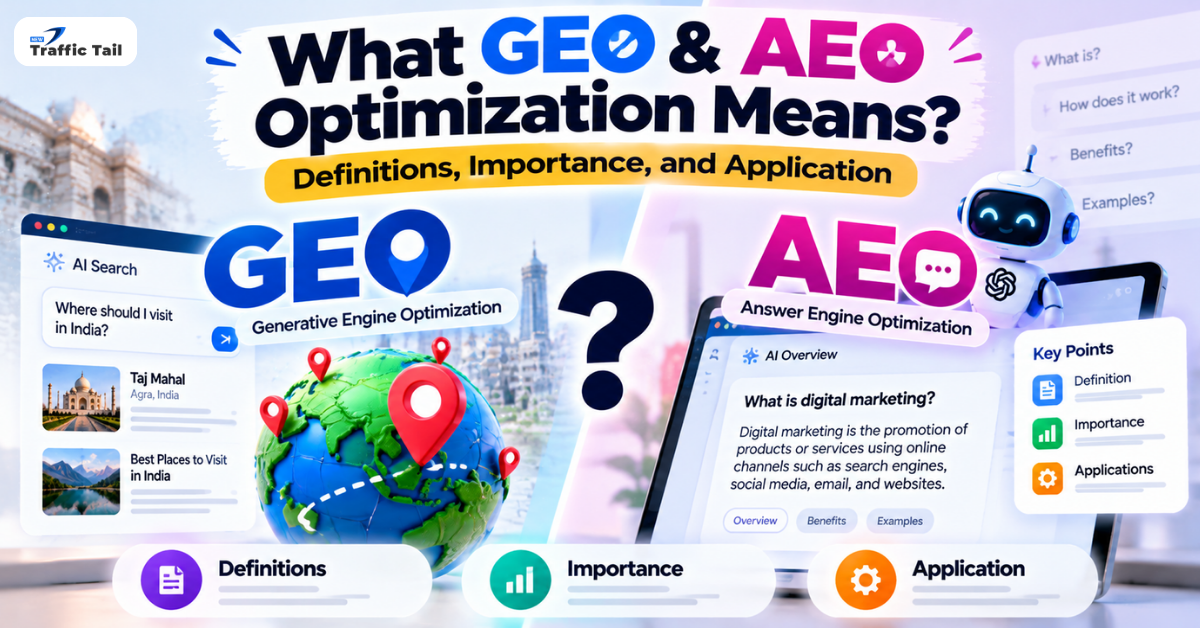
You may have started seeing terms like GEO (Generative Engine Optimization) and AEO (Answer Engine Optimization) popping up in marketing conversations. These aren’t just buzzwords invented to sell consulting services — they describe real and distinct strategies that address how AI systems discover, extract, and present information.
GEO focuses on making your content easy for generative AI tools to interpret, extract, and cite accurately. This means structured content, clear authorship signals, well-labeled data, and content that directly addresses specific questions rather than dancing around them.
AEO is about engineering your content so it gets pulled into “answer boxes” — those short, direct responses AI tools surface when someone asks a specific question. If someone asks
“What’s the best CRM for a small law firm?” and your content answers that question clearly and authoritatively, AI tools are more likely to surface your answer.
The brands winning in search right now are the ones combining traditional SEO with GEO and AEO — meeting users wherever they’re searching, whether that’s Google, ChatGPT, voice assistants, or something else entirely.
Content Quality Has Never Mattered More
Here’s something that might surprise you given all the talk about AI: the emphasis on genuine, human-driven content quality has actually increased, not decreased.
AI-generated content is everywhere. Readers sense it, even if they can’t always name it. And search algorithms — which have grown remarkably sophisticated at detecting thin, low-value, or inauthentic content — are penalizing it.
What this means for your content strategy is straightforward: depth, expertise, and authenticity are your competitive moat.
Content that performs well in 2026 tends to share a few traits:
- It answers questions specifically and completely, not in vague generalities
- It reflects genuine expertise — opinions backed by experience, data, or real-world knowledge
- It demonstrates E-E-A-T (Experience, Expertise, Authoritativeness, and Trustworthiness) throughout
- It’s written for a real human reader first, with search signals as a secondary consideration
This is actually good news for businesses that know their industry well. If you’re a plumber who’s been unclogging drains for twenty years, a financial advisor who’s navigated three market cycles, or a software company that genuinely solves a specific problem — that expertise, written clearly and honestly, is exactly what AI search systems are trying to surface.
The Rise of Predictive and Semantic Search
Keyword research used to be a fairly mechanical process: find high-volume terms, sprinkle them into your copy, build some links. In 2026, that approach is not just outdated — it actively misunderstands how modern search works.
Today’s AI-powered search doesn’t just match keywords. It interprets intent — navigational, transactional, informational, and even emotional context behind a query. Google and OpenAI’s models now evaluate user engagement signals, real-time trends, and contextual meaning alongside keyword relevance.
For businesses, this means the question isn’t “What keywords should I rank for?” but rather “What problems is my audience trying to solve, and am I the best answer to those problems?”
Tools like Semrush’s Keyword Wizard, Ahrefs, and Google’s own Vertex AI now incorporate predictive models that help businesses anticipate audience intent — not just respond to it. Smart businesses are moving from reactive keyword targeting to proactive content planning built around clusters of related questions, problems, and topics.
If your entire blog strategy is built around chasing high-volume head terms, it’s time for a rethink.
Voice Search and Multimodal Discovery
Voice search has been “the next big thing” for years now, but in 2026, it’s simply a thing — a meaningful and growing share of how people interact with search, especially on mobile and smart devices.
Voice queries are conversational by nature. Nobody asks their phone “best Italian restaurant nearby.” They say, “What’s a good Italian place around here that’s open right now and not too expensive?” The intent is the same; the structure is completely different.
Optimizing for voice means writing content that sounds natural when read aloud, answering questions in direct and conversational language, and ensuring your local search presence is impeccably maintained. Google Business Profile completeness, accurate hours, and genuine customer reviews have become surprisingly important signals for voice and local AI search results.
Beyond voice, image and video search are growing faster than most businesses are prepared for. AI tools can now interpret product images, compare visual styles, and answer questions about what’s in a photo. If your business is visual — interior design, food, fashion, architecture, retail — and you’re not optimizing your visual content with proper metadata, alt text, and structured markup, you’re leaving real discovery opportunities on the table.
What This Means for Your Business Strategy
Let’s get practical. Here’s what businesses should actually be doing in 2026:
1. Audit your technical foundation first. Before any AI optimization strategy can work, your website needs to be technically sound. Page speed, mobile responsiveness, crawlability, and clear site structure aren’t exciting, but they’re non-negotiable.
2. Invest in structured data. Schema markup — the code that tells search engines exactly what your content is about — has become one of the most important technical signals for AI-powered search. FAQs, reviews, products, events, and articles all benefit from proper structured data implementation.
3. Create content that’s genuinely extractable. AI systems favor content that is clearly organized, answers questions directly, and is easy to parse. Clear headings, concise answers, and logically structured pages aren’t just good UX — they’re increasingly important for AI citation.
4. Build real authority, not just links. Links still matter, but the nature of authority has shifted toward demonstrable expertise. Bylines with credentials, cited sources, data-backed claims, and consistent publishing on your core topic build the kind of trust signals that both readers and AI systems recognize.
5. Track beyond traditional rankings. If your SEO reporting still leads with “We moved from position 7 to position 4 for this keyword,” it’s time to expand your metrics. AI referral traffic, citation presence in AI Overviews, engagement depth, and assisted conversions are increasingly important signals of how well your SEO strategy is actually working.
When to Bring in Expert Help
Managing SEO in 2026 is genuinely more complex than it was even three years ago. The technical landscape, the content requirements, the proliferation of AI search platforms, and the sheer pace of algorithm changes mean the stakes of getting it wrong — or simply doing nothing — are higher than ever.
For many businesses, partnering with a reputable SEO agency that understands both traditional search fundamentals and the emerging AI optimization landscape is the most pragmatic path forward. The right agency brings not just tools and tactics, but the kind of strategic perspective that’s hard to develop in-house when your core business is, understandably, not search engine optimization.
That said, working with any agency works best when you come to the table with a clear understanding of what you want to achieve — traffic, leads, brand visibility, local dominance — and the patience to treat SEO as a long-term investment, not a quick fix.
The Deeper Truth About SEO in 2026
Here’s something worth stepping back to appreciate: despite all the algorithm changes, AI integrations, and new acronyms, the fundamental goal of search hasn’t changed. Search engines — and now AI systems — are trying to connect people with the most genuinely useful, trustworthy, and relevant answer to their question.
Every major update, from Google’s Panda and Penguin years ago to today’s AI Overviews, has consistently rewarded businesses that are actually good at what they do and can communicate that clearly online. The businesses that struggled were almost always the ones trying to game the system rather than serve their audience.
That hasn’t changed. If anything, AI search has made it more true.
The businesses that will thrive in search over the next few years aren’t necessarily the ones with the biggest budgets or the most sophisticated tech stacks. They’re the ones that know their customers deeply, communicate their expertise honestly, and show up consistently with content that genuinely helps people make decisions.
AI is changing the mechanics of how people find you. But the underlying principle — be genuinely worth finding — has never been more relevant.
Final Thoughts
SEO in 2026 is not simpler than it was. It requires understanding new platforms, new optimization disciplines, and a more nuanced view of what visibility actually means. But for businesses willing to invest in the right foundations, it also represents a real opportunity to stand out at a moment when a lot of competitors are confused, overwhelmed, or still doing things the old way.
The search landscape is being rewritten in real time. The businesses that show up with genuine expertise, well-structured content, and a clear understanding of what their audience needs — those are the ones that will be cited, referenced, and found.
Start there, and the rest becomes a lot more manageable.
Have questions about your business’s SEO strategy in the AI era? The landscape is changing fast, but the core principles are clearer than ever — and getting started today puts you ahead of most.